
Reflex finds the workflows you keep re-explaining to Claude Code, Codex and Cursor, and turns them into reusable skills. Runs entirely on your machine.


Install · Quick start · How it works · Features · Terminal UI · Commands · Supported agents · FAQ · Docs
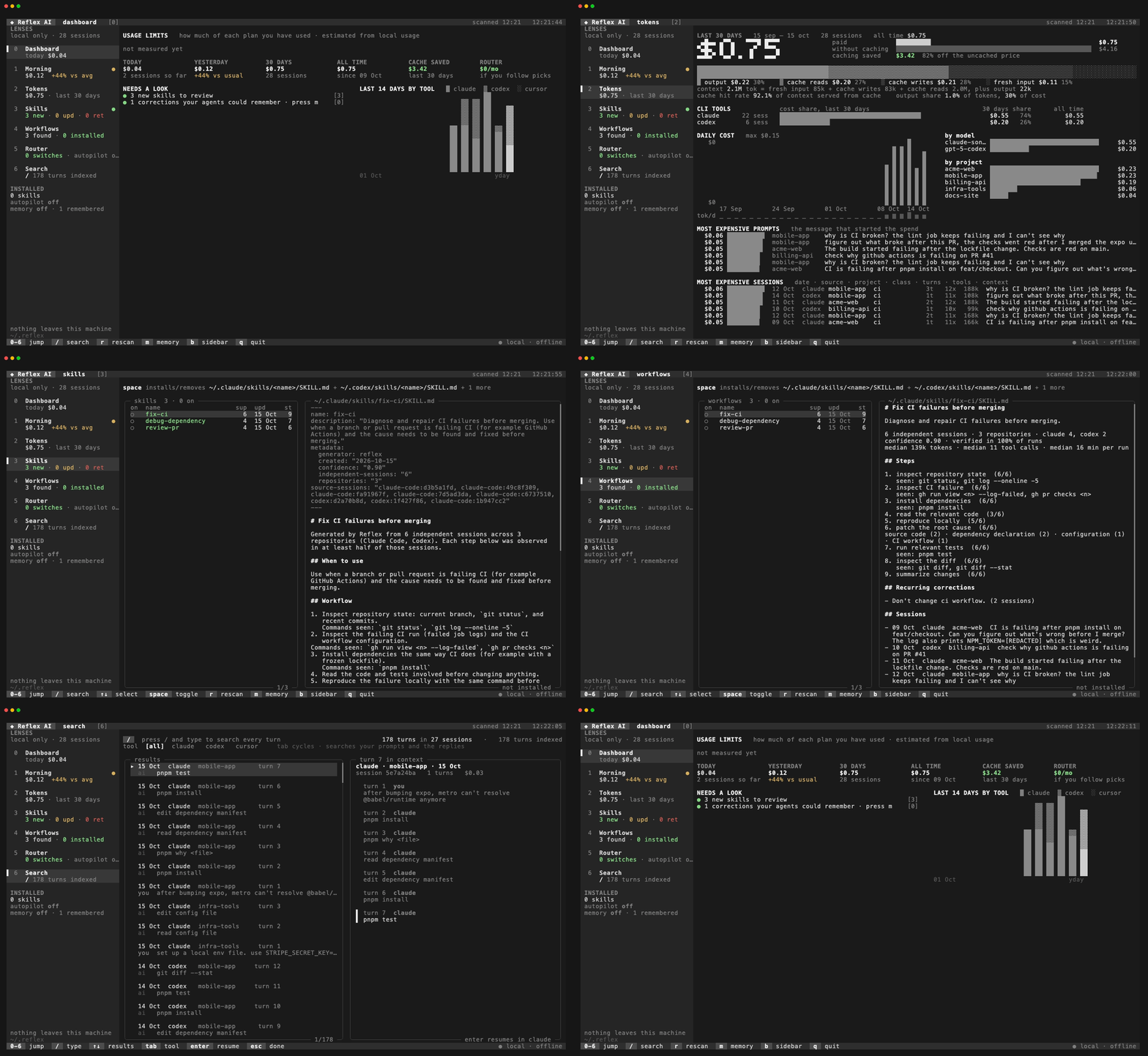
The terminal UI, opened with reflex. What each view does. Recorded on the synthetic test history in packages/test-fixtures, not real sessions.
Coding agents start every session fresh. If you fix CI the same way every week, you explain the same steps every week: which logs to read, which commands to run, what not to touch.
Reflex reads the session history your agents already keep on disk, finds tasks you have repeated in
at least 3 independent sessions, and writes the steps they had in common into a skill. A skill is a
SKILL.md file of reusable instructions; Claude Code, Codex and Cursor pick installed skills up
when a new session starts. You review the evidence and approve each skill before anything is
installed.
Requires Node.js 22.13 or newer.
npm install -g reflex-skills # installs the `reflex` command (the npm name `reflex` is a different package)Or try it without installing. doctor shows what Reflex can see without reading anything:
npx reflex-skills doctorreflex scan --days 30 # read your Claude Code / Codex / Cursor history (asks first)
reflex suggest # review suggestions: [a]pprove, [e]vidence, [r]eject
reflex install <name> # copy an approved skill into Claude Code, Codex and/or Cursor (asks per target)
reflex # open the terminal UI over the last scan
If a short window finds nothing, try a longer one, or match more loosely with
reflex settings matching --sessions 2 --strictness looser. docs/demo.md walks through the
whole loop on your own history.

- Scan. Reflex asks per source, then reads your agents' history locally. Secrets, emails, home paths and your user name are redacted before anything is stored.
- Detect. Each session becomes a trace of what was asked and what was done. Traces that match across at least 3 independent sessions become a suggestion; one-offs never do.
- Review. Each suggestion shows its evidence: the sessions, the steps and how many sessions had each one, and corrections you repeated. You approve or reject it.
- Install. An approved skill is written to
~/.reflex/skillsand copied into the agents you choose. Installs never overwrite an existing file.
Details: How detection works.
- Skills from your own repeats. Only steps seen in at least half the sessions, with example commands that recurred and passed a safety filter. No transcript excerpts.
- A terminal UI.
reflexopens seven views over your last scan: Dashboard, Morning, Tokens, Skills, Workflows, Router and Search.spaceinstalls or removes a skill. docs/tui.md - Token and cost view. Tokens from the last scan and what they would cost at API list prices,
per day, tool, model and project, and what caching saved. Add or correct prices in
~/.reflex/prices.json(how). - A model router and bench.
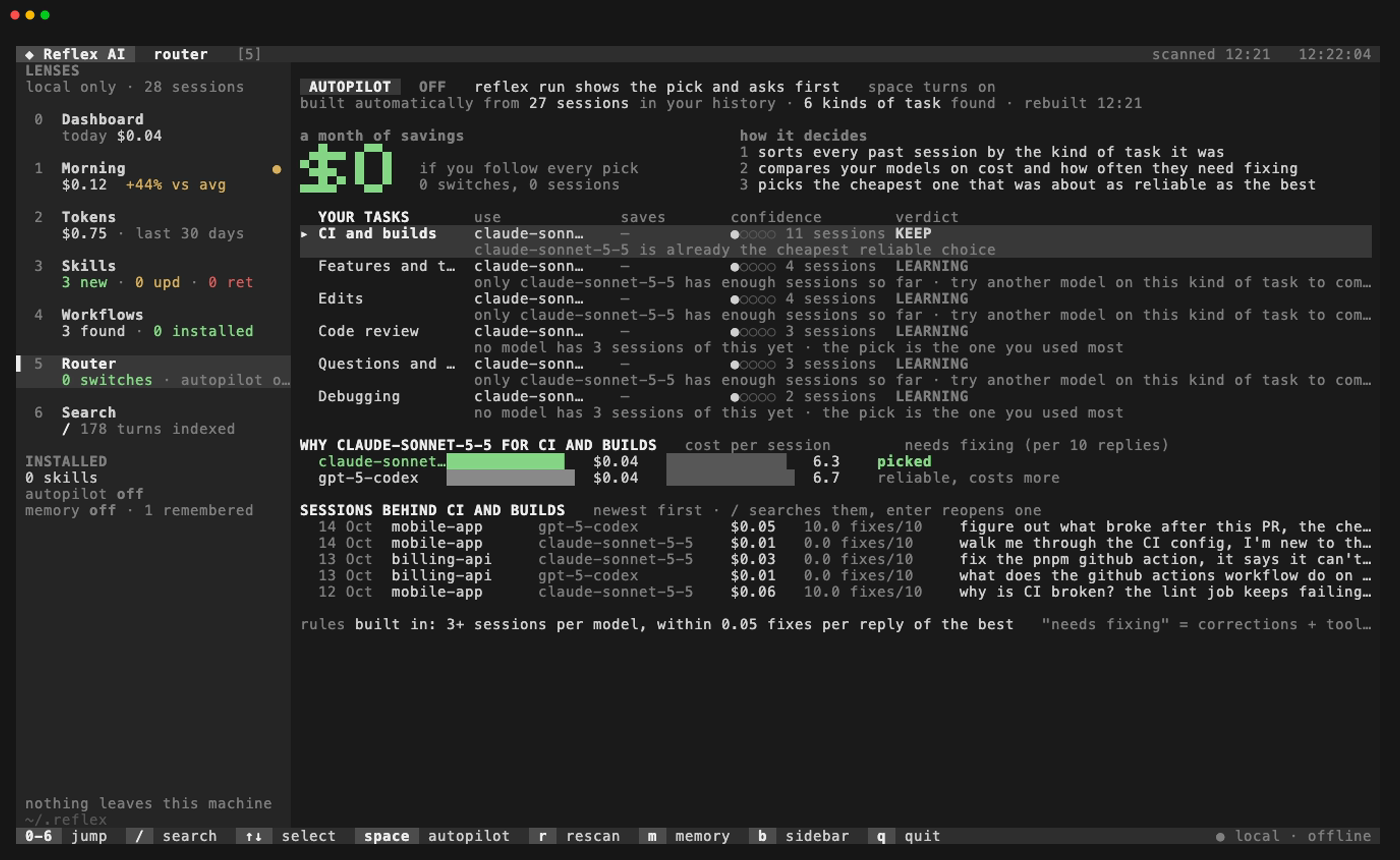
reflex runstarts Claude Code or Codex on the cheapest model that needed fixing about as rarely as the most reliable one for that kind of task;reflex benchruns one task on several models and scores them with your check command. Routing tasks to models - Improve skills you already have.
reflex improve <skill>compares a skill with the sessions that loaded it and proposes an edit, asking before it reads or changes anything. - Memory. Corrections you gave in at least 2 independent sessions, written as a marked block into
~/.claude/CLAUDE.mdand~/.codex/AGENTS.mdonce you runreflex memory on. - A handbook per repository.
reflex handbooklists the commands that worked in a repository, the ones that kept failing and the corrections you repeated, with the sessions behind each. Read-only, so agents can call it;exportwrites one for a teammate. - Cursor token counts. Cursor saves none in its transcripts;
reflex cursor-usage onrecords them through a Cursor hook from then on, so Cursor sessions get a cost too.
Run reflex after a scan. You can do the whole loop from here (Skills, Workflows), and also see what your agent usage costs and reopen old sessions. Keys 0-6 switch views. More: docs/tui.md.
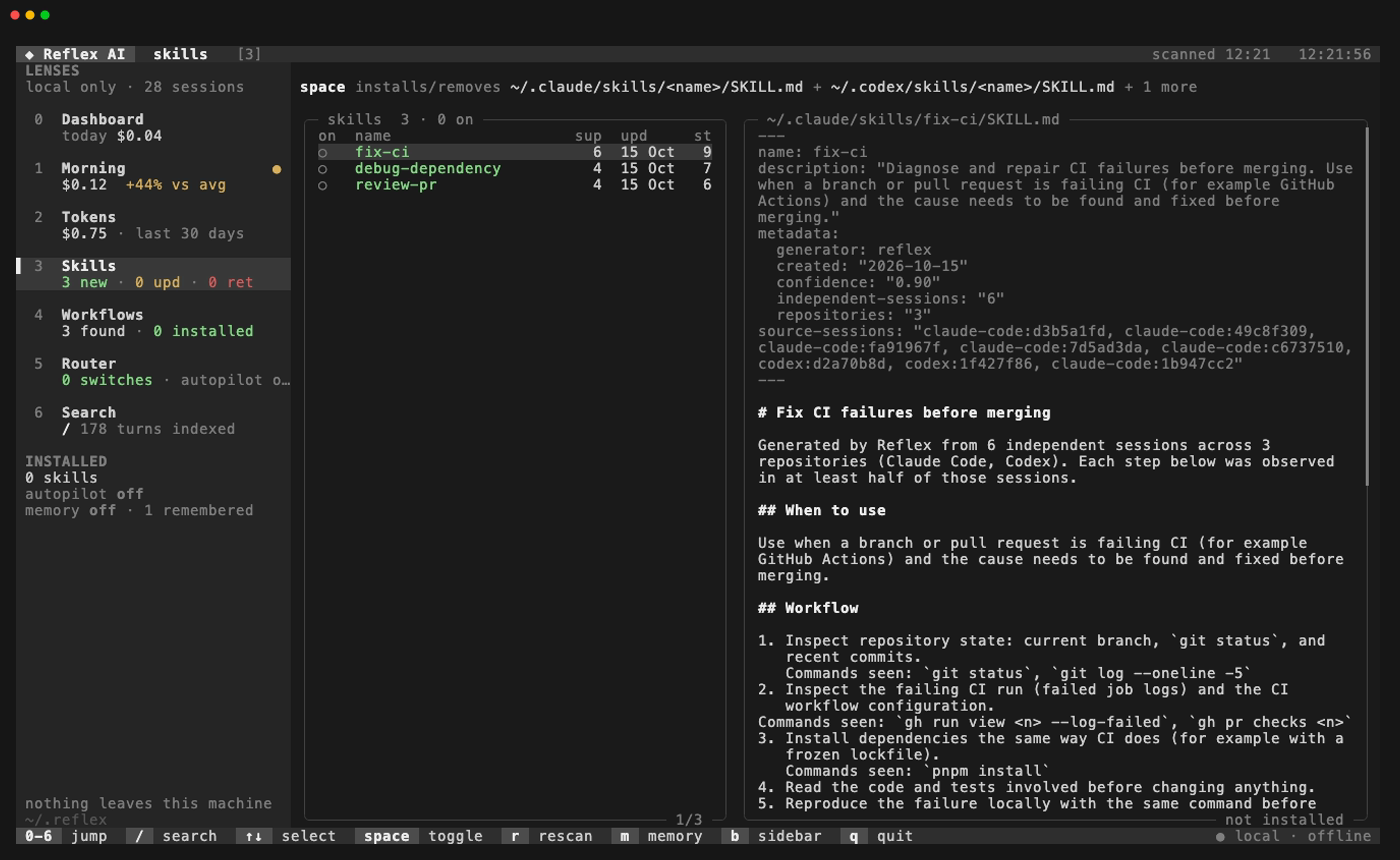
Suggested skills with the SKILL.md they would write. space approves one and installs it into every agent Reflex detects, or removes it again. The same loop as reflex suggest and reflex install, in one keypress.
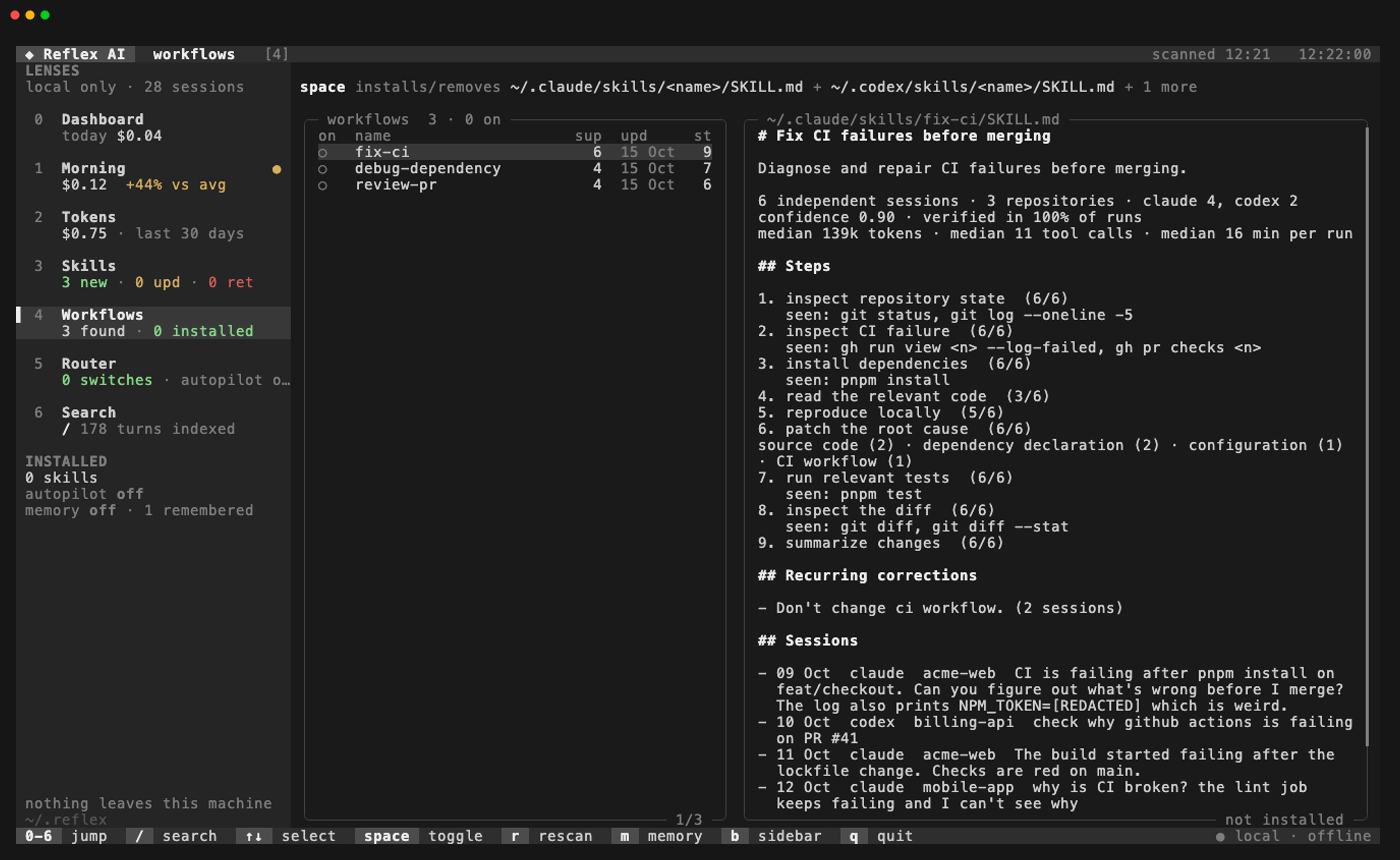
Every repeated workflow Reflex found: each step with how many sessions had it, corrections you repeated, cost per run, and the sessions themselves.
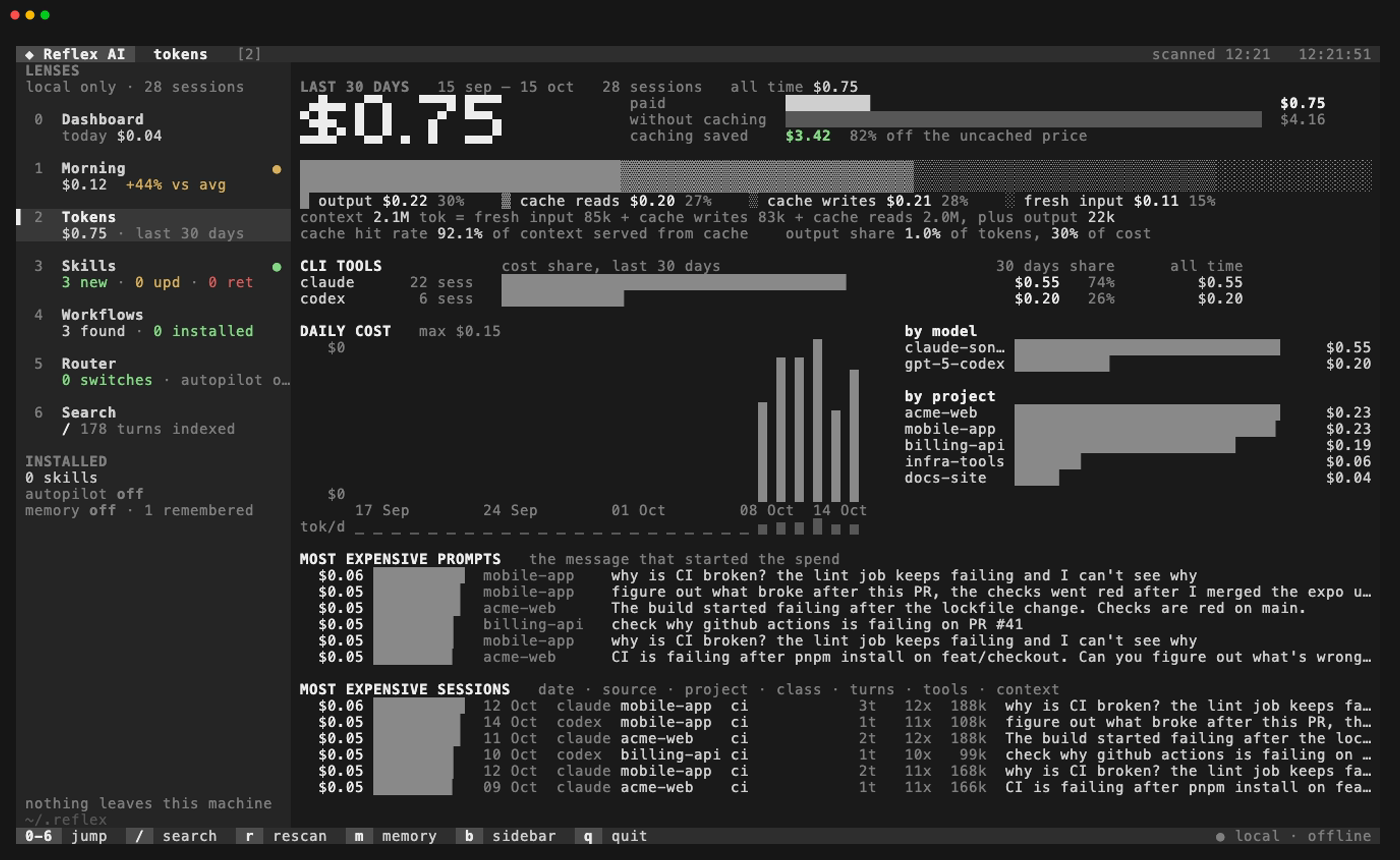
More views: Tokens, Router, Search
Tokens from the last scan and what they would cost at API list prices, per day, tool, model and project, plus how much caching saved and your most expensive sessions.
For each kind of task, the cheapest model that needed fixing about as rarely as the most reliable one. space turns autopilot on for reflex run.
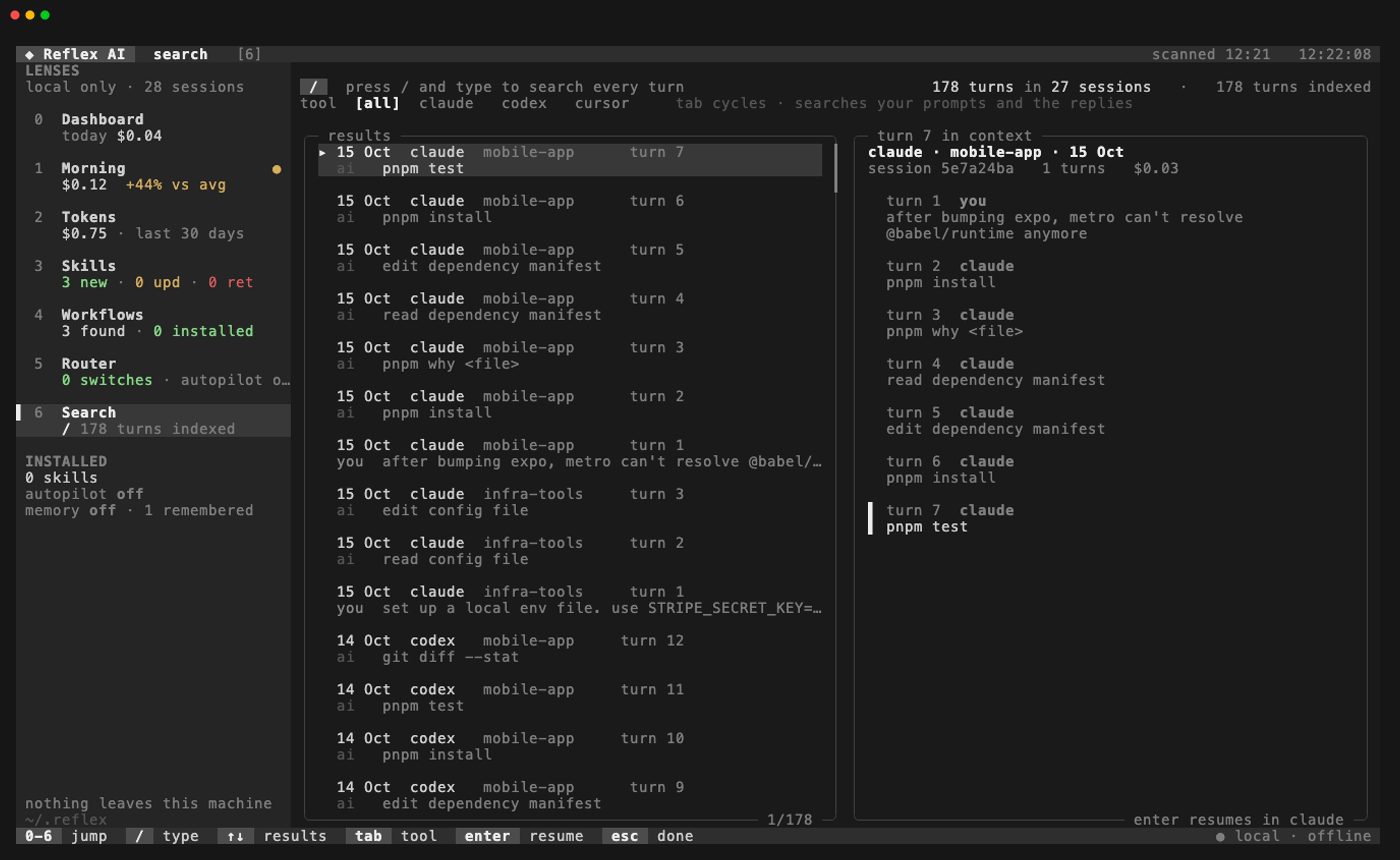
Every scanned session's opening request and steps. Enter reopens it in Claude Code or Codex, or opens a Cursor chat's workspace.
| Command | What it does | |
|---|---|---|
| Find skills | reflex doctor |
What Reflex can see: history locations and file counts, install targets. Reads nothing |
reflex scan --days <n> |
Read your agents' history (asks per source) and store redacted traces | |
reflex suggest |
Review repeated workflows one by one: approve, see evidence, reject | |
reflex show <n> · evidence <n> |
One suggestion in detail · the sessions behind it | |
reflex approve <n> · reject <n> |
Generate its SKILL.md · stop suggesting it |
|
| Install | reflex install <name> |
Copy a skill into Claude Code, Codex and/or Cursor. Never overwrites |
reflex skills · show-skill <name> |
Generated skills and where they're installed · print one | |
reflex explain <name> |
Why a skill exists: sessions, repositories, agents, steps | |
| Explore | reflex |
The terminal UI: dashboard, tokens, skills, workflows, router, search |
reflex sessions · agents · stats |
Sessions from the last scan · agents they launched · counts | |
| Measure and improve | reflex impact <name> |
Tokens and tool calls per run before vs. after the skill |
reflex validate <name> |
Check a skill; --run proves it in a fresh Claude Code session |
|
reflex improve <skill> |
Compare a skill you already have with the sessions that loaded it and propose an edit | |
| Pick models | reflex run "<request>" |
Start Claude Code or Codex on the model the router picks (--dry-run shows why) |
reflex route |
Picks per kind of task, autopilot, exploration and bench results | |
reflex bench "<task>" --check "<cmd>" |
Run one task on several models, scored by your check command | |
| Memory | reflex memory on · off |
Tell new sessions the corrections you keep repeating, via CLAUDE.md / AGENTS.md |
reflex handbook |
How work is done in this repository: commands that worked, ones that failed, repeated corrections | |
| Setup | reflex model fetch |
Optional local model for matching requests by meaning (--light for 23 MB). It also downloads the 14 MB WebAssembly runtime it runs on, from the npm registry, verified |
reflex cursor-usage on |
Record Cursor's token counts through a Cursor hook (not on Windows yet) | |
reflex settings matching |
How many sessions make a repeat (2-5) and how strictly they must match | |
reflex forget |
Remove older sessions, or ones whose transcript was deleted, from Reflex's data | |
reflex settings retention |
Keep only the last N days of sessions, forgetting older ones after each scan | |
reflex reset |
Delete Reflex's own data (not installed skills) |
Prompts default to No; without a terminal nothing is read or written unless you pass --yes.
Every option: docs/commands.md.
| Agent | Reads history | Installs skills | Status |
|---|---|---|---|
| Claude Code | ✓ | ✓ | Tested on fixtures matching real files; skill use verified with validate --run |
| Codex | ✓ | ✓ | Tested on fixtures; not yet run against real rollouts or a live Codex session |
| Cursor | ✓ | ✓ | Tested on fixtures and real agent transcripts. No command results, so no pass/fail outcome; tokens and cost only while reflex cursor-usage is on. reflex doctor lists what is missing |
Sessions run through Conductor are read with Claude Code and Codex. Locations and overrides: Sources in detail.
- Transcripts are read locally; scans make no network connections. The only command that uses the
network is
reflex model fetch, which you run yourself to download an optional model. - Secrets, emails, home paths and your user name are redacted before anything is stored or shown.
- Nothing is written outside
~/.reflexuntil you install a skill, turn on memory or the Cursor hook, or apply areflex improveedit, each after asking. Details: docs/security.md
Does Reflex send my sessions anywhere?
No. Scans make no network connections, and outgoing sockets are blocked in Reflex's own process.
reflex model fetch downloads an optional embedding model when you run it and uploads nothing.
Does Reflex itself use my Claude or OpenAI account?
Scanning, suggesting and installing don't. Commands that start an agent do, after asking:
reflex run, reflex bench, reflex validate --run and reflex improve --verify.
Why didn't it suggest anything?
A workflow needs the same kind of task in at least 3 independent sessions; copies, resumed sessions
and quick retries count once. Try a longer window (reflex scan --days 30), or lower the bar with
reflex settings matching --sessions 2 --strictness looser. With the optional model
(reflex model fetch), requests worded differently can match too.
Will it change my CLAUDE.md, AGENTS.md, Cursor hooks or existing skills?
Only if you ask. reflex memory on writes a marked block into ~/.claude/CLAUDE.md and
~/.codex/AGENTS.md and leaves the rest of each file as it was; reflex memory off removes it.
reflex cursor-usage on adds Reflex's hook to ~/.cursor/hooks.json, keeps your other hooks and
backs the file up first; off removes it. Installs never overwrite a file, and reflex improve asks
before it changes a skill and keeps a backup.
How do I remove everything?
reflex reset deletes Reflex's own data and its Cursor hook. Installed skills stay; in reflex tui, space on an
installed skill removes the copies Reflex wrote, unless you edited them. To remove only some sessions, use
reflex forget --missing (transcripts you deleted) or reflex forget --older-than <days>;
reflex settings retention <days> does the second after every scan.
Known gaps, from the current docs:
- Run the Codex parser against real rollouts and a live Codex session (it is checked against Codex's source today)
- Read agents launched from Claude Code sessions (Cursor's are read today)
- Read Cursor and OpenCode sessions run through Conductor
- Measure usage limits in the TUI (shows
not measured yettoday) - Record Cursor's token counts on Windows (
reflex cursor-usageis macOS and Linux only)
- Commands: every command and option
- Guide: how detection works, matching by meaning, improving your skills, measuring a skill, routing tasks to models, prices, sources and limitations
- Terminal UI · Security · Architecture · Walkthrough
- Development: building from source and running the tests
Reflex is early: version 0.x, and commands and output may change between releases. Confidence scores are a ranking heuristic, not a probability.
Sponsor integrations (Alike, Darwin) are not included: no public API documentation was available to build against, and the product works without them.
Issues and pull requests are welcome.
pnpm install
pnpm build       # bundles the CLI to apps/cli/dist/reflex.js
pnpm test        # vitest across all packages
pnpm typecheck
pnpm lint
The monorepo uses pnpm workspaces and Turborepo with strict TypeScript, Zod for untrusted records,
and built-in node:sqlite for storage, so there are no native dependencies. The optional embedding
model runs on onnxruntime-web's WebAssembly backend for the same reason. Packages live in
packages/*; the CLI in apps/cli. packages/test-fixtures holds synthetic transcripts used only
by the tests; it is not part of the published CLI. More in docs/development.md; internals: docs/architecture.md.
The README recordings are reproducible on synthetic data: vhs docs/assets/tui-tour.tape and
vhs docs/assets/quickstart.tape.
MIT © The Reflex contributors. The npm package also ships
dist/THIRD_PARTY_NOTICES.md with the licenses of the libraries bundled into it.