A starting point for VST3 + CLAP plugins in Rust for macOS and Windows, built with nice-plug, with the build and release setup from Patina. The plugin itself is a gain knob with a webview editor, there to prove the setup works.
It pins the same nice-plug fork as Patina
(starzonmyarmz/nice-plug),
which adds ActivateContext::gui_context() so MIDI controllers can set
parameters before the editor opens.
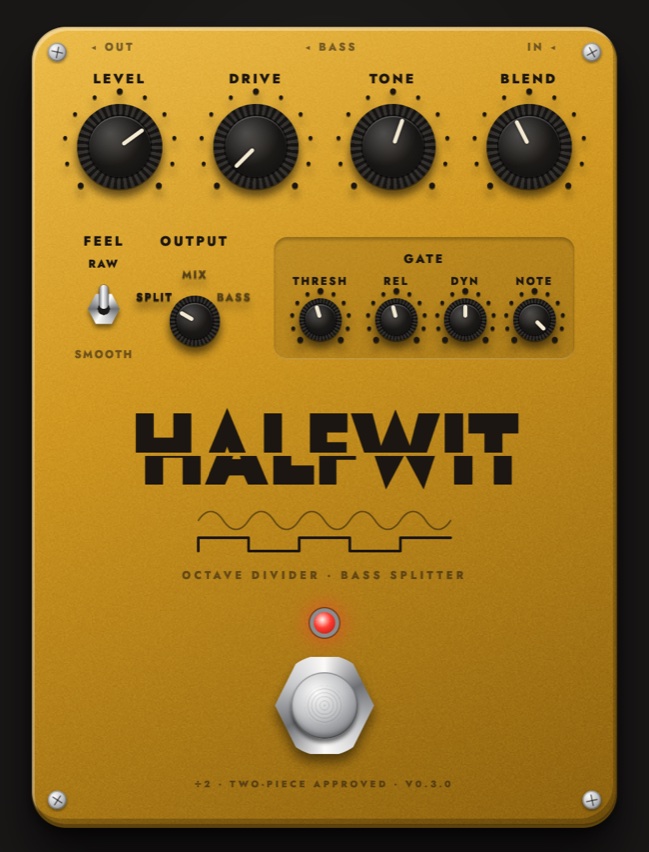
- Halfwit: an octave-divider bass layer for guitar, as a stompbox.
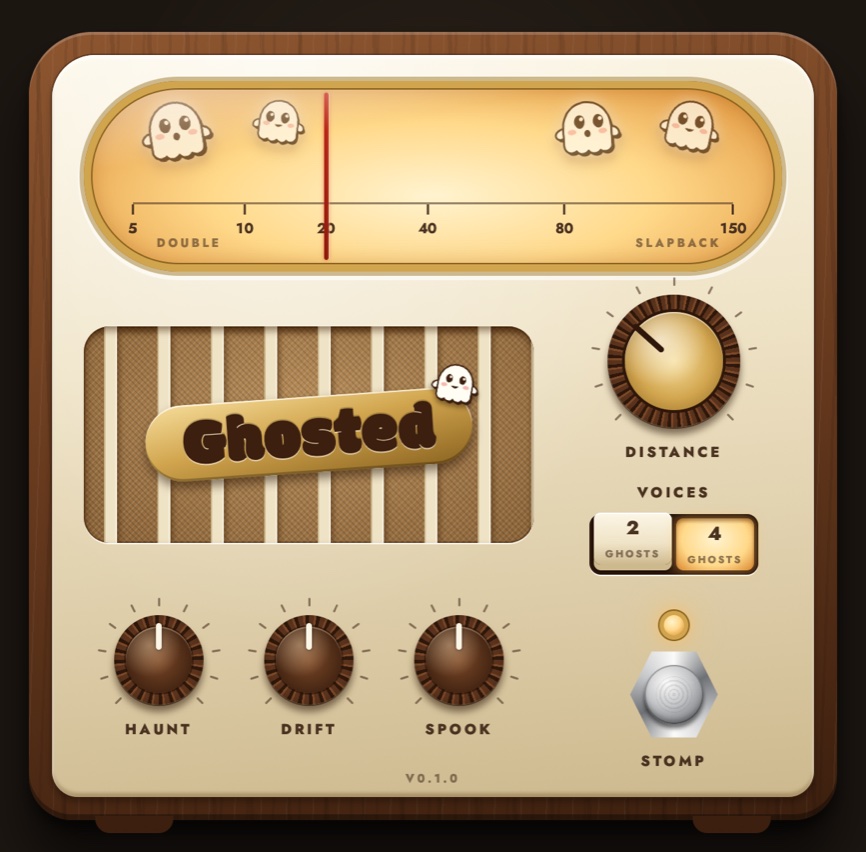
- Ghosted: drifting double-tracking, from ADT to slapback, as a vintage radio.
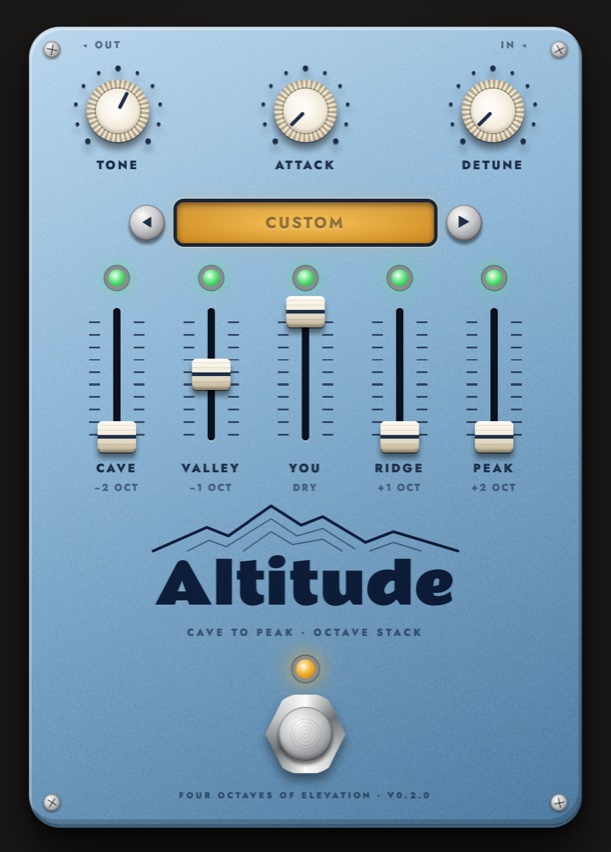
- Altitude: stacked octaves, two down to two up, with presets, as a screen-printed stompbox.
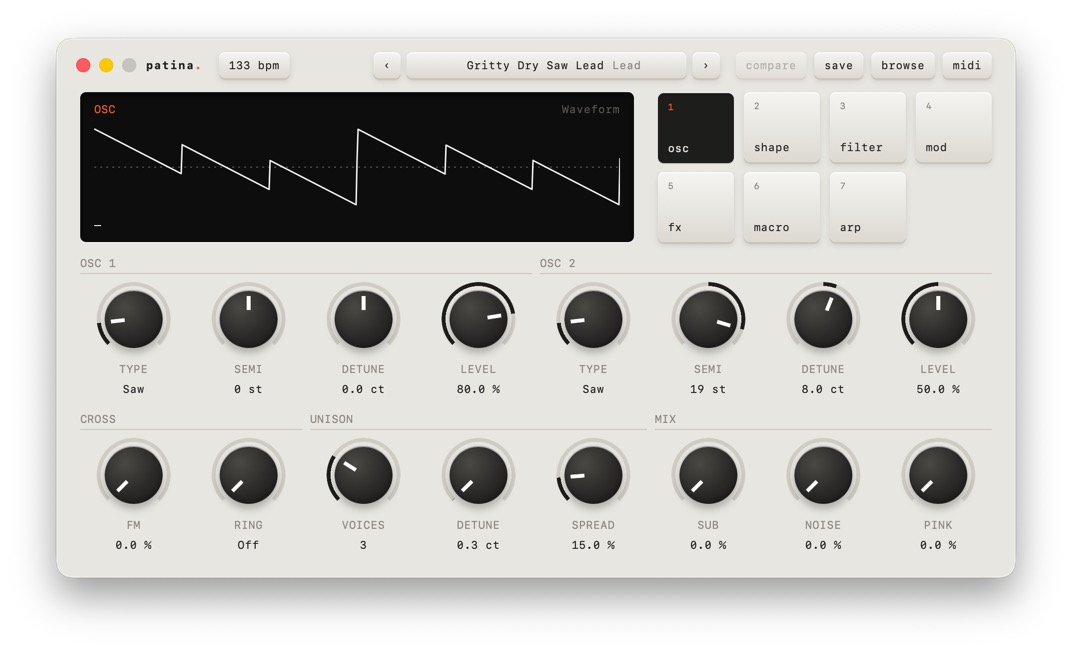
- Patina: a polysynth and Mac app. It came first, and the template's build and release setup comes from it.
Every plugin gets its own look, but they share an approach.
- Skeuomorphic. The editor is a physical object (Patina an OP-1-style synth, Halfwit a stompbox, Ghosted a vintage radio), with real materials like powder coat, bakelite, walnut, brass and grille cloth, built in CSS gradients and shadows rather than images.
- One theme. Pick the object from the plugin's vibe and name, and let it run through everything: the wordmark, the art and the control labels. Names should be playful and capture the vibe.
- Restrained. One knob style and colour family per plugin, and few controls. Fold many settings into a handful of knobs with evocative names rather than exposing every one.
- Colour and art mean something. If two waves or knobs differ in colour, it's because they differ in function; otherwise make them the same. Art can follow parameters (Ghosted's ghosts fade with Haunt, the dial needle follows Distance), but don't fake audio metering.
- Plain labels. Words a guitarist understands, not DSP terms or fieldset jargon. Numbers go in a tooltip readout.
- Type with character. Embed a display face for the wordmark (Futura-like Jost, pillowy Modak), never a system or "commercial" font, and centre it optically on its badge.
- Drawn, not vector-perfect. Vary repeated elements (size, tilt, expression), and give outlines weight that swells on the shadow side, like inked comic art.
- A footswitch on effects. Pedals and other effects get an on/off
toggle (
stomp, on by default). Off fades the effect out and passes the dry signal; a lamp or LED shows the state, and the art reacts (Ghosted's dial dims and its ghosts leave). - The version on the panel. Print it small and quiet as part of the
object, like a model number on a pedal's base plate or a serial plate on
a radio's back (
v1.2.0), so anyone can tell which build they're running. It comes fromversionin the rootCargo.toml. - Physical details behave physically. Shadows stay put while a knob turns, pressed keys sink, lit things glow.
Click Use this template on GitHub (or gh repo create --template), then rename Example. CLAUDE.md has the rest of the routine:
| What | Where |
|---|---|
Crate name (example) |
plugin/Cargo.toml, bundler.toml, CRATE in both workflows, crate in scripts/install.sh, use example:: in plugin/tests/engine.rs |
Display name (Example) |
bundler.toml, NAME and PAGE.title in plugin/src/lib.rs, PLUGIN in both workflows, INSTALL.txt, <title> in ui/index.html, the usage line in scripts/clap-validator.sh |
Dev URL env var (EXAMPLE_UI_URL) |
PAGE.dev_url_var in plugin/src/lib.rs |
| Plugin IDs | CLAP_ID and VST3_CLASS_ID (exactly 16 bytes) in plugin/src/lib.rs. These must be unique, and must never change after a release. |
| Description, features, subcategories | ClapPlugin and Vst3Plugin in plugin/src/lib.rs |
cargo xtask bundle example --release       # target/bundled/Example.{vst3,clap}
scripts/install.sh                         # bundle, sign ad hoc and install on macOS
scripts/clap-validator.sh target/bundled/Example.clapThe DSP lives in plugin/src/engine.rs, apart from the host plumbing in
lib.rs, so cargo test can run it offline. The plugin passes parameter
values to the engine once per block.
plugin/tests/support has helpers for checking sound, not just numbers:
read_wavloads test input, such as a guitar DI checked intoplugin/tests/di.check_goldencompares a render withplugin/tests/golden/<name>.wav. After an intended change to the sound, rerun withBLESS=1to rewrite the golden files, then listen to them before committing.check_golden_stereodoes the same for a stereo render, stored as a stereo WAV, for effects whose width matters.tonemakes a test note with a few harmonics, for checks that don't need a recording.
plugin/tests/engine.rs shows the pattern: render through the engine
in host-sized blocks, then compare with a golden file or assert on the
output directly.
check.ymlruns on pushes to main and on PRs: the tests and clap-validator on macOS, and clap-validator on the Windows build.release.ymlruns onvX.Y.Ztags. The tag must matchversionin the rootCargo.toml. It builds a universal macOS bundle and a Windows bundle, validates both, and publishesExample-X.Y.Z.zipwithINSTALL.txt. A version with a suffix (1.0.0-beta.1) becomes a prerelease.screenshot.ymlruns on pushes to main that touchui/, the version orplugin/src/lib.rs. It retakesdocs/example.jpgwithscripts/screenshot.sh, sets its width in the README, and commits both if the image changed. It doesn't run in the template itself.
To release: bump version in Cargo.toml, commit, then
git tag vX.Y.Z && git push origin main vX.Y.Z.
Rebase the fork's patina branch onto newer nice-plug, push it, and update
the rev in plugin/Cargo.toml and xtask/Cargo.toml.
The editor is a wry webview in a
baseview window, showing
ui/index.html, which is compiled into the plugin.
plugin/src/editor.rshosts the page.PAGEinlib.rsis its only config: title, size, HTML, the background shown until the page paints, and an env var that loads the page from a dev server instead.plugin/src/bridge.rsconnects the page to any#[derive(Params)]struct throughparam_map(). The page sendsready, thenbegin,setandendwith normalized values; the plugin answers withinit(the plugin's version, and each parameter's id, name, step count, options and default) andvalues(normalized value and the plugin's formatted text).- Host keys go to the page only while something on it has focus, so shortcuts like play keep working.
The starter page builds a knob for every parameter, or a switch for two-step ones, so a new plugin has a working UI right away. Replace it with a hand-laid page once the controls settle; Halfwit's pedal is an example.
Without the plugin, the page runs against a mock bridge in
ui/index.html. Keep the mock's parameters in step with the plugin's,
then work on the page in a browser:
cd ui && python3 -m http.server 8765 # open http://127.0.0.1:8765Add ?version=1.2.0 to show a version other than 0.0.0. Set
EXAMPLE_UI_URL to that URL before starting the host to load it
live in the plugin.
Fonts can't load from the network in the plugin: embed them as base64
@font-face data URLs, and keep the font file and its license in
ui/fonts.
Copy it from Patina (app/). It isn't here yet because it's built
around Patina's parameters, and the reusable shape should come from the
second plugin that needs one. Guitar plugins will also need audio input
selection, which Patina's app doesn't have.