






Stream training data from cloud storage to every GPU: fast, deterministic and resumable.
The maintained fork of MosaicML Streaming. import streaming and your MDS datasets work unchanged, now with transformers 5, numpy 2.5 and Python 3.14.
Install • Quick start • Why this fork • Features • Storage • Migrating • Docs
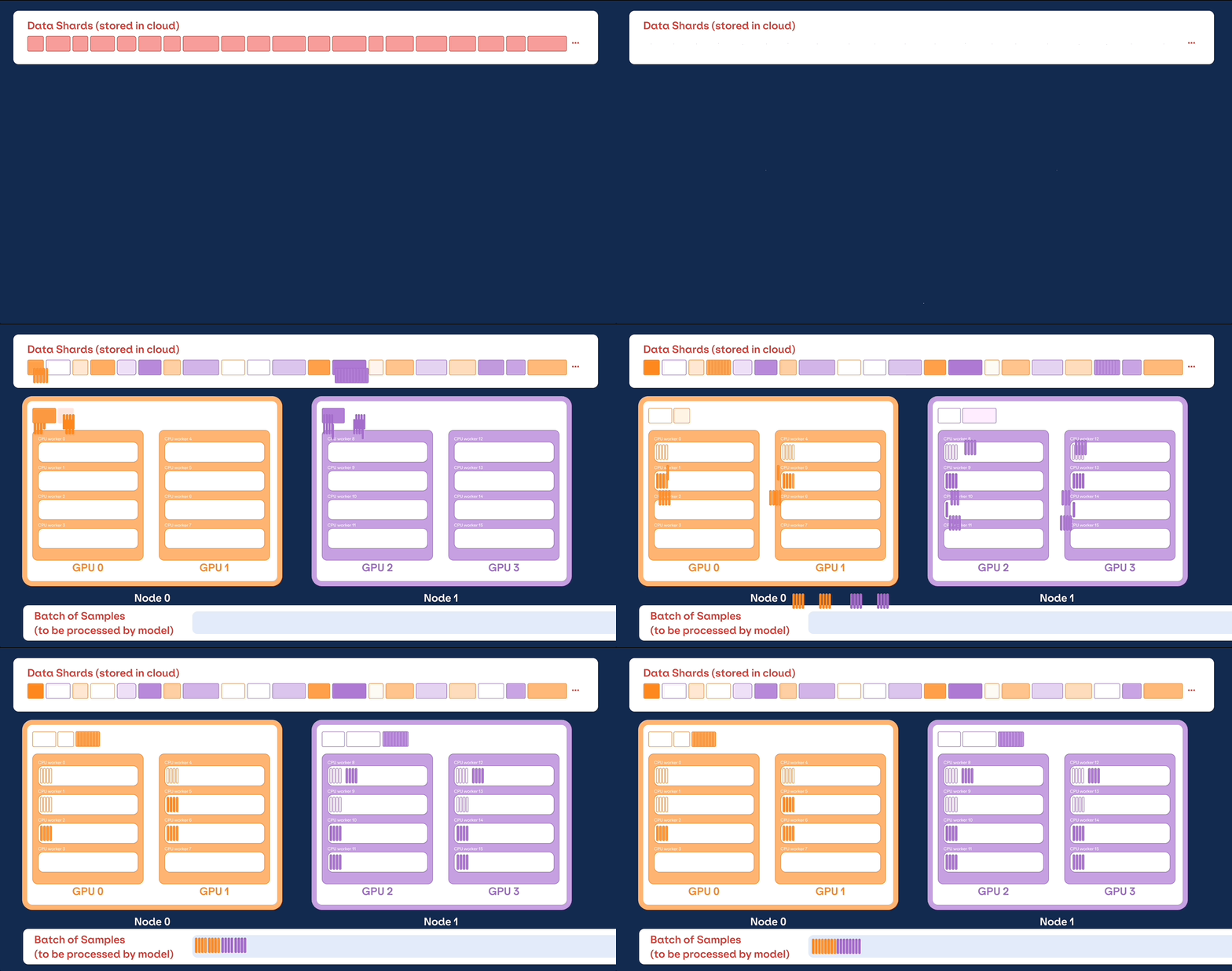
- Drop-in. Same
import streaming, same MDS, JSON and CSV/TSV formats, samestate_dictkeys. Golden tests check that datasets, sample order and checkpoints written by 0.13.0 still read the same. - Installs with today's stack.
transformers<6,numpy<3,huggingface_hub<3andpyspark<5, and CI checks on every change that[all]resolves with numpy 2.5 and transformers 5. - Tested on Python 3.10 to 3.14 on every pull request.
- Bugs fixed: cache eviction no longer deletes local-only shards, the shared-memory prefix race is gone, and file locks and PNG encoding work with filelock 4 and Pillow 13.
- Released regularly to PyPI through trusted publishing, with a changelog for every version.
pip install streaming-communityS3 and S3-compatible stores, Google Cloud Storage, Azure, OCI and SFTP work out of the box. Optional extras:
| Extra | Adds |
|---|---|
hf |
Hugging Face Hub datasets (hf://) |
databricks |
Databricks Unity Catalog volumes and DBFS (dbfs:/) |
spark |
dataframe_to_mds, converting Spark DataFrames to MDS |
alipan |
Alipan (alipan://) |
simulator |
the simulator app for tuning shuffle quality and throughput |
pip install "streaming-community[hf,databricks]"Moving from mosaicml-streaming? Uninstall it first; see Migrating.
Write samples as MDS shards, then stream them into a PyTorch DataLoader:
import numpy as np
from torch.utils.data import DataLoader

from streaming import MDSWriter, StreamingDataset

# 1. Write samples as compressed MDS shards. `out` can also be a cloud path such as s3://bucket/dataset.
columns = {'image': 'ndarray:uint8', 'label': 'int'}
with MDSWriter(out='/tmp/streaming-quickstart', columns=columns, compression='zstd', exist_ok=True) as out:
    for i in range(1000):
        out.write({'image': np.random.randint(0, 256, (32, 32, 3), dtype=np.uint8), 'label': i % 10})

# 2. Stream them back. For a cloud dataset, pass remote='s3://bucket/dataset' and a local cache directory.
dataset = StreamingDataset(local='/tmp/streaming-quickstart', batch_size=32, shuffle=True)
batch = next(iter(DataLoader(dataset, batch_size=32)))
print(batch['image'].shape, batch['label'][:8])
Next steps: main concepts, converting your dataset, cloud credentials, and end-to-end tutorials for CIFAR-10, FaceSynthetics and SyntheticNLP.
| Feature | What you get | |
|---|---|---|
| 🎛️ | Seamless data mixing | Mix any number of Streams by proportion, repeat or sample count, shuffled together just in time. |
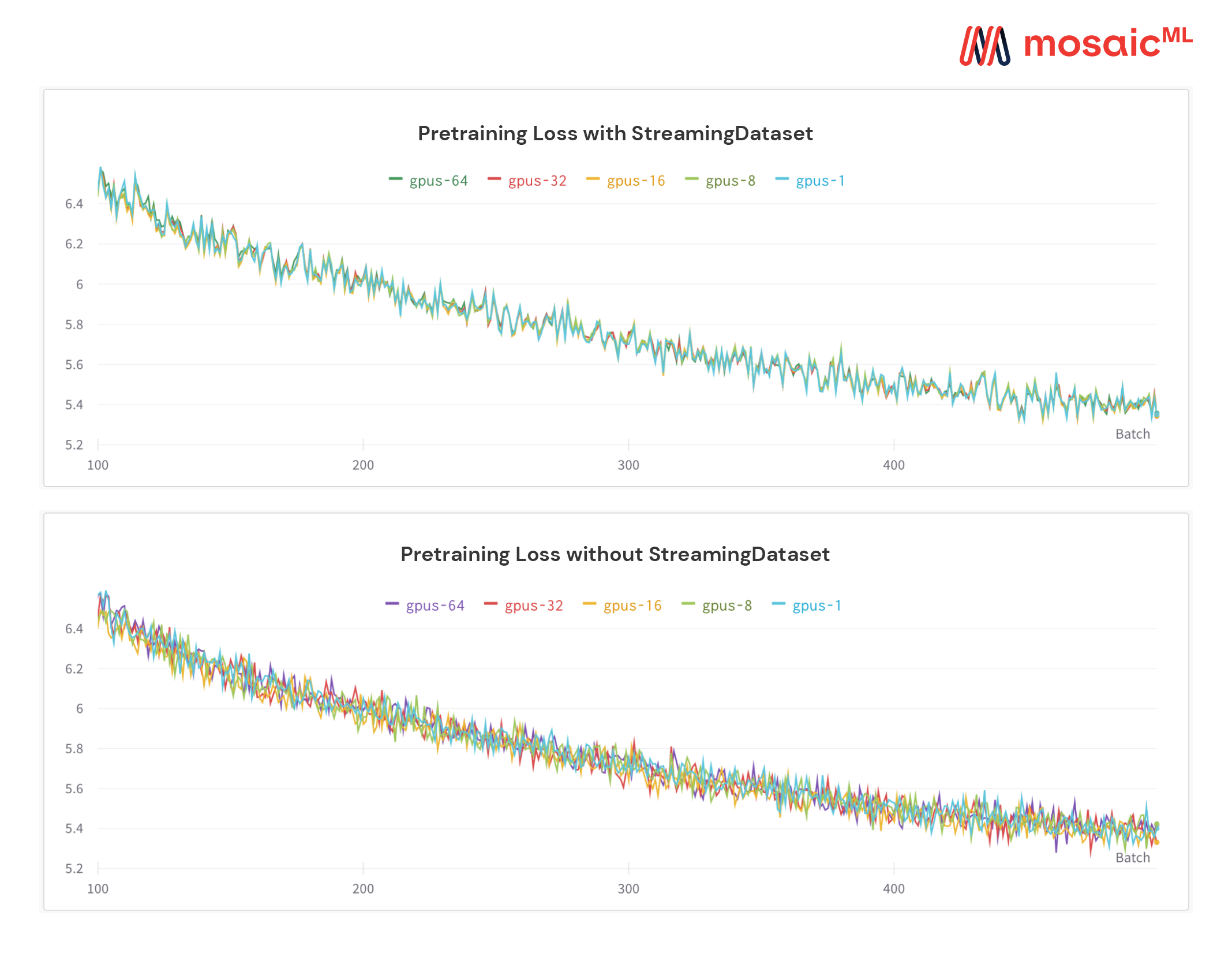
| 🎯 | True determinism | The same sample order on 1 or 64 GPUs and any number of nodes or workers, so runs and loss spikes reproduce. |
| ⏯️ | Instant mid-epoch resumption | Resume a long run from a checkpoint in seconds instead of replaying the epoch. |
| 🚀 | High throughput | The MDS format keeps per-sample overhead minimal for dataloader-bound workloads. |
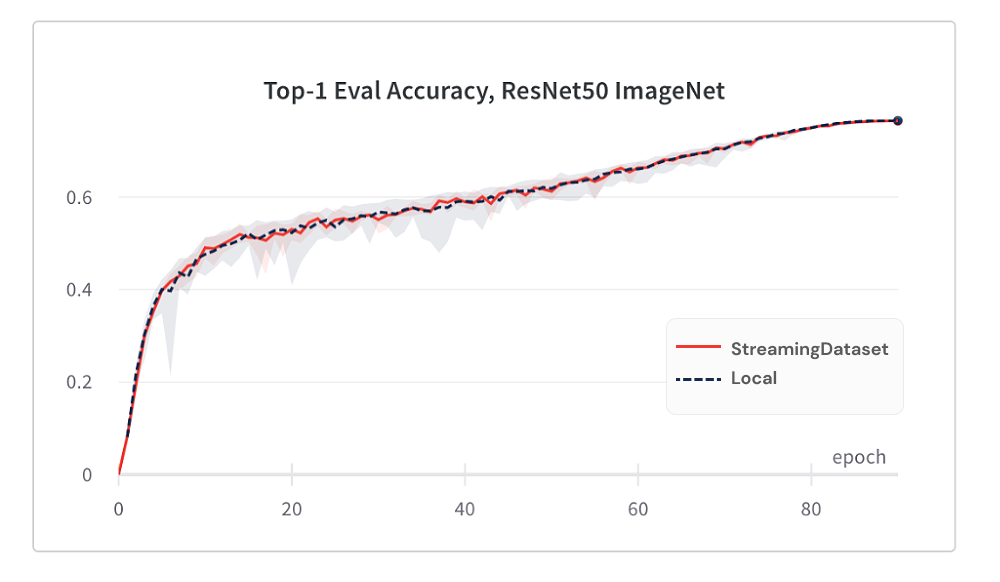
| 📈 | Equal convergence | Shuffling across all samples on a node converges like training from local disk. |
| 🔍 | Random access | dataset[i] works even before sample i is downloaded. |
| 🧮 | No divisibility requirements | Any number of samples on any number of devices; samples are repeated, never dropped. |
| 💽 | Disk usage limits | cache_limit='100gb' evicts least recently used shards to stay under budget. |
Mixing datasets in code
# mix C4, github code, and internal datasets
streams = [
  Stream(remote='s3://datasets/c4', proportion=0.4),
  Stream(remote='s3://datasets/github', proportion=0.1),
  Stream(remote='gcs://datasets/my_internal', proportion=0.5),
]

dataset = StreamingDataset(
  streams=streams,
  samples_per_epoch=1e8,
)
Determinism, convergence and throughput results
Results measured for the original MosaicML Streaming on ImageNet with ResNet-50, collected over 5 repetitions.
Training on 1, 8, 16, 32 or 64 GPUs yields the exact same loss curve, up to the limits of floating-point math:
Convergence matches training from local disk:
| Tool | Throughput | Top-1 accuracy |
|---|---|---|
| StreamingDataset | ~19000 img/sec | 76.51% +/- 0.09 |
| ImageFolder | ~18000 img/sec | 76.57% +/- 0.10 |
| WebDataset | ~16000 img/sec | 76.23% +/- 0.17 |
Throughput is measured after the data is cached in the first epoch.
| Storage | Remote path | Install |
|---|---|---|
Amazon S3 and S3-compatible stores (set S3_ENDPOINT_URL) |
s3://bucket/path |
included |
| Google Cloud Storage | gs://bucket/path |
included |
| Azure Blob Storage / Azure Data Lake | azure:// / azure-dl:// |
included |
| Oracle Cloud Infrastructure | oci://bucket/path |
included |
| SFTP | sftp://host/path |
included |
| Hugging Face Hub | hf://datasets/org/name |
[hf] |
| Databricks Unity Catalog / DBFS | dbfs:/Volumes/... / dbfs:/... |
[databricks] |
| Alipan | alipan://path |
[alipan] |
| Local disk | /path/to/dataset |
included |
Shard formats: MDS (recommended), JSON and CSV/TSV. See dataset formats.
| Supported | Checked in CI | |
|---|---|---|
| Python | 3.10 to 3.14 | full test suite on each version |
| PyTorch | >=1.10,<3 |
current release, CPU |
| transformers | >=4.21.3,<6 |
resolves with transformers 5 |
| numpy | >=1.21.5,<3 |
resolves with numpy 2.5 |
streaming-community is a community fork of MosaicML Streaming. The last upstream release, 0.13.0, was published on 2025-07-15 and no release has followed. That release pins transformers<5, so it cannot be installed together with transformers 5, and it pins numpy<2.2, so with numpy>=2.2 pip and uv silently fall back to 0.10.0, the last release without the numpy pin. This fork publishes the same library as streaming-community with current dependency bounds.
What stays the same, and migrating from mosaicml-streaming
What stays the same:
- the import name,
import streaming - the MDS, JSON and XSV shard formats and
index.jsonversion 2 - the
state_dictkeys used for mid-epoch resumption - the environment variable names
Migrating from mosaicml-streaming:
-
Uninstall the upstream package first. Both distributions install into the
streaming/package directory, so they cannot be installed side by side.pip uninstall mosaicml-streaming pip install streaming-community
-
Projects that pin
mosaicml-streaming, such as composer<1.0and llm-foundry>=0.12.0,<0.13, would pull the upstream package back in. With uv, drop their requirement with an override inpyproject.toml:[tool.uv] override-dependencies = ["mosaicml-streaming ; sys_platform == 'never'"]
pip has no dependency override. Install such a project with
pip install --no-depsand add its other requirements yourself.
Upstream remains at https://github.com/mosaicml/streaming; see NOTICE for attribution.
Starter code for popular datasets
We also have starter code for the following popular datasets, which can be found in the streaming directory:
| Dataset | Task | Read | Write |
|---|---|---|---|
| LAION-400M | Text and image | Read | Write |
| WebVid | Text and video | Read | Write |
| C4 | Text | Read | Write |
| EnWiki | Text | Read | Write |
| Pile | Text | Read | Write |
| ADE20K | Image segmentation | Read | Write |
| CIFAR10 | Image classification | Read | Write |
| COCO | Image classification | Read | Write |
| ImageNet | Image classification | Read | Write |
To start training on these datasets:
- Convert raw data into .mds format using the corresponding script from the
convertdirectory.
For example:
$ python -m streaming.multimodal.convert.webvid --in <CSV file> --out <MDS output directory>- Import dataset class to start training the model.
from streaming.multimodal import StreamingInsideWebVid
dataset = StreamingInsideWebVid(local=local, remote=remote, shuffle=True)
🏆 Project showcase
Here are some projects and experiments that used StreamingDataset. Got something to add? Open a pull request.
- BioMedLM: a Domain Specific Large Language Model for BioMedicine by MosaicML and Stanford CRFM
- Mosaic Diffusion Models: Training Stable Diffusion from Scratch Costs <$160k
- Mosaic LLMs: GPT-3 quality for <$500k
- Mosaic ResNet: Blazingly Fast Computer Vision Training with the Mosaic ResNet and Composer
- Mosaic DeepLabv3: 5x Faster Image Segmentation Training with MosaicML Recipes
- …more to come! Stay tuned!
We welcome contributions, pull requests and issues.
- Questions and ideas: Discussions
- Bugs and feature requests: Issues
- Contributing: CONTRIBUTING.md
- Security reports: SECURITY.md
- Release notes: CHANGELOG.md
If you like this project, give us a star ⭐
✍️ Citation
@misc{mosaicml2022streaming,
    author = {The Mosaic ML Team},
    title = {streaming},
    year = {2022},
    howpublished = {\url{<https://github.com/mosaicml/streaming/>}},
}