
Finite Automata are a graph-based representation commonly used to efficiently evaluate whether strings belongs to the language generated by a regular grammar. Put more simply, they let us check if a given string is valid under some syntactical rules. Performing these checks is used everywhere from validating emails in a text input to building compilers for programming languages, so it is critical we have efficient and developer-friendly interfaces.
To address this need, our library exposes functions for constructing, converting, evaluating, and visualizing Finite Automata and Regular Expressions.
Step 1: Clone this library and place it in your include directory.
cd path/to/include

git clone https://github.com/mattperls-code/finite-automata.git
Step 2: Compile the library locally using the make recipe.
cd finite-automata

make library.a
Step 3: Link the resulting binary when you compile.
g++ -std=c++23 main.cpp path/to/include/finite-automata/library.a -o main Step 4: You can now access the Regular Expression and Finite Automata header files.
// main.cpp

#include <iostream>

#include "path/to/include/finite-automata/src/regular_expression.hpp"
#include "path/to/include/finite-automata/src/finite_automata.hpp"

using namespace std;

int main()
{
    RegularExpression re = RegularExpression::fromExpressionString("ab*");

    cout << "REGULAR EXPRESSION:" << endl;
    cout << re.toString() << endl << endl;

    FiniteAutomata fa = FiniteAutomata::re2lnfa(re);

    cout << "FINITE AUTOMATA:" << endl;
    cout << fa.toString() << endl << endl;

    return 0;
}
Expected output of executing main:
REGULAR EXPRESSION:
ab*

FINITE AUTOMATA:
States: A, B, C
Start State: A
Accepting States: C
Edges:
        From A via a to B
        From B via b to C
        From B via λ to C
        From C via λ to B
// matches the empty string
static RegularExpression RegularExpression::empty();

// matches a single character
static RegularExpression RegularExpression::character(char c);

// matches two concatenated regular expressions
static RegularExpression RegularExpression::concat(
  RegularExpression re1,
  RegularExpression re2
);

// matches if either regular expression matches
static RegularExpression RegularExpression::plus(
  RegularExpression re1,
  RegularExpression re2
);

// matches complete repetitions of a regular expression
static RegularExpression RegularExpression::star(RegularExpression re);// e.g. match character "a" followed by any number of "b"
static RegularExpression RegularExpression::fromExpressionString("ab*");// produce a formal syntax string
string RegularExpression::toString();
// produce a LaTeX code string
string RegularExpression:toLatex();string RegularExpression::exportExpression(
string outputDirPath,
string outputFileName
);static FiniteAutomata FiniteAutomata::create(
unordered_set<string> states,
string startState,
unordered_set<string> acceptingStates,
unordered_set<Edge> edges
);// convert a Regular Expression to a Lambda-NFA
static FiniteAutomata FiniteAutomata::re2lnfa(RegularExpression re);
// convert a Lambda-NFA to a Regular Expression
RegularExpression FiniteAutomata::lnfa2re();
// convert a Lambda-NFA to a NFA
FiniteAutomata FiniteAutomata::lnfa2nfa();
// convert a NFA to a DFA
FiniteAutomata FiniteAutomata::nfa2dfa();
// convert a DFA to its Minimal DFA
FiniteAutomata FiniteAutomata::dfa2minDfa();
// convert a DFA to its Complement
FiniteAutomata FiniteAutomata::dfa2complement();// check if two Finite Automata have isomorphic graphs
static bool FiniteAutomata::isIsomorphism(
FiniteAutomata dfa1,
FiniteAutomata dfa2
);
// check if two Finite Automata represent equivalent graphs
static bool FiniteAutomata::isLanguageEquivalence(
FiniteAutomata fa1,
FiniteAutomata fa2
);bool FiniteAutomata::matches(string str);// produce a human-readable description of a Finite Automata
string FiniteAutomata::toString();
// produce DOT file code for a Finite Automata
string FiniteAutomata::toDOT();void FiniteAutomata::exportGraph(
string outputDirPath,
string outputFileName
);The app directory contains example code snippets for the library.
Remember to change the include directory to your path/to/include.
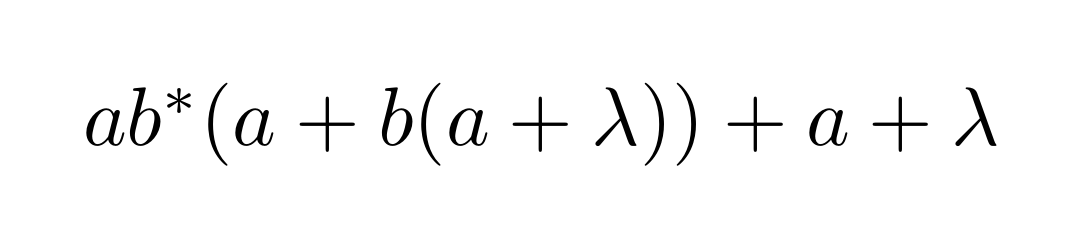
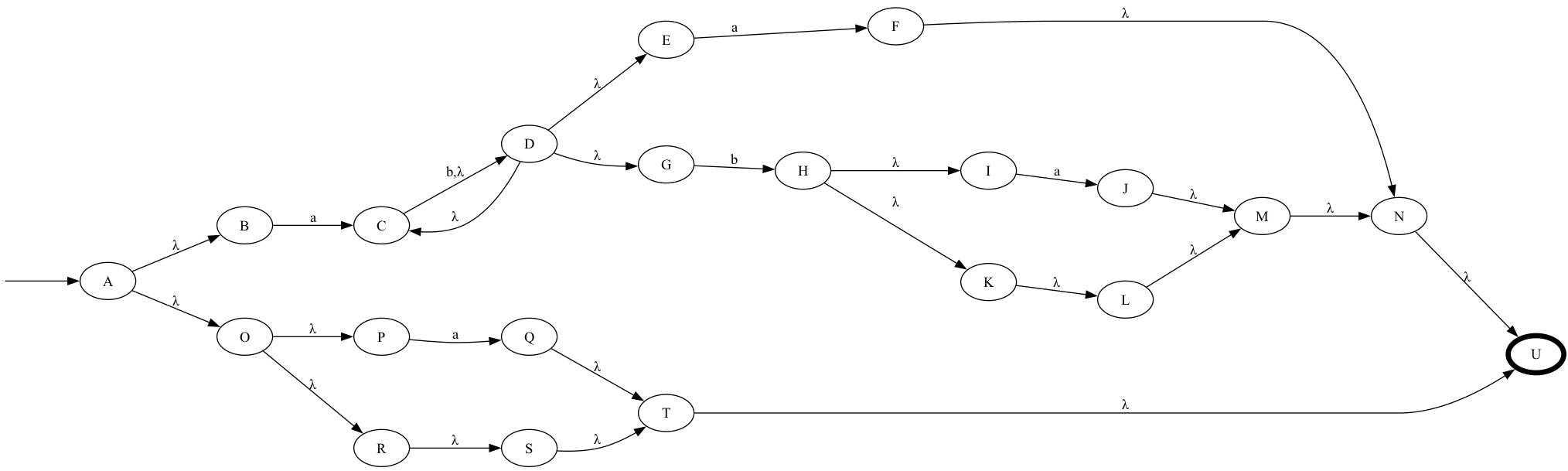
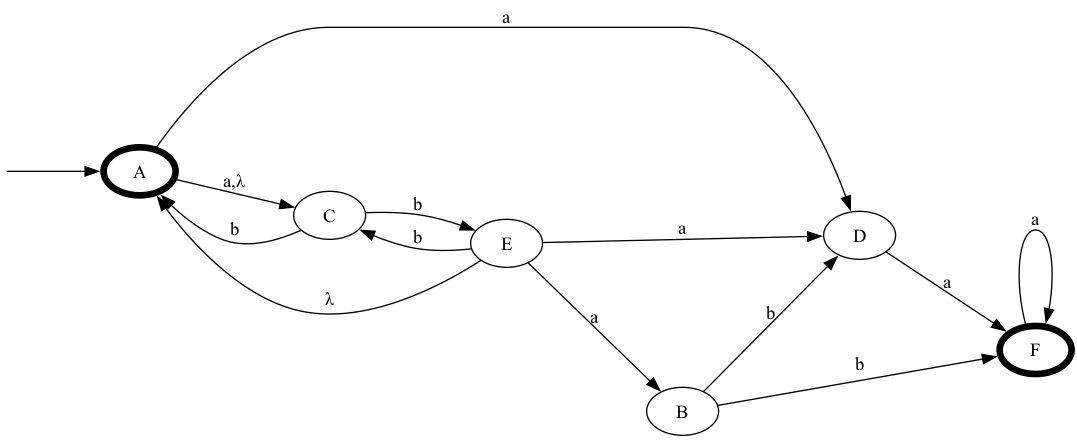
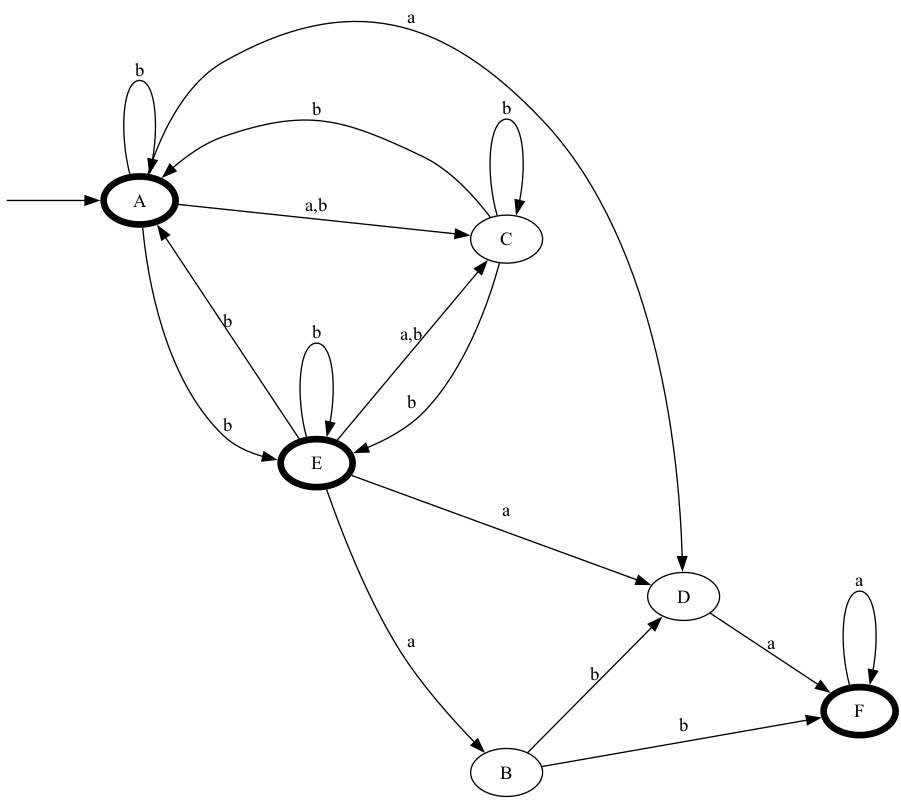
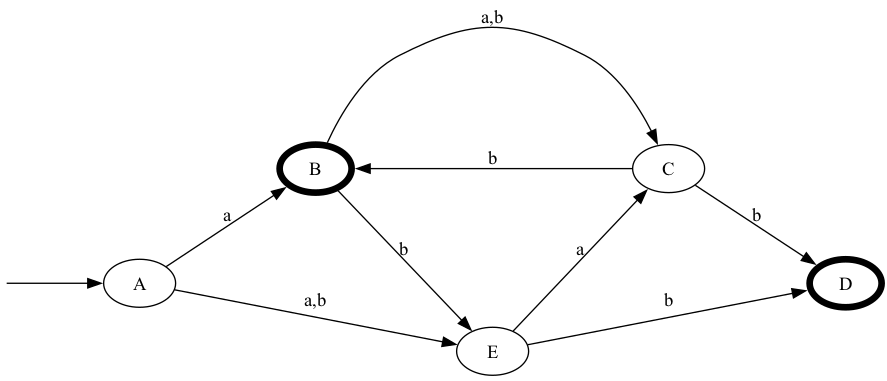
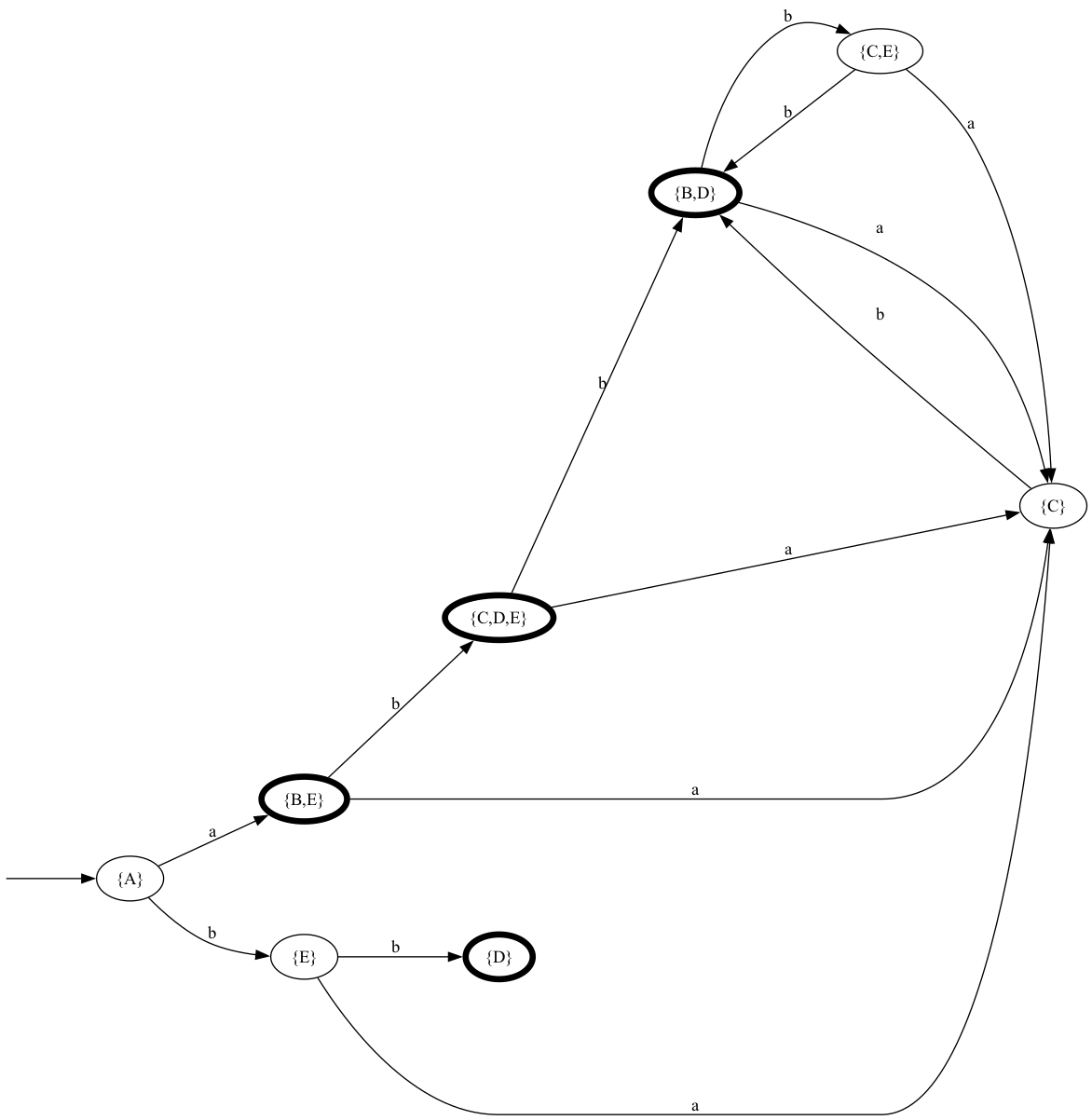
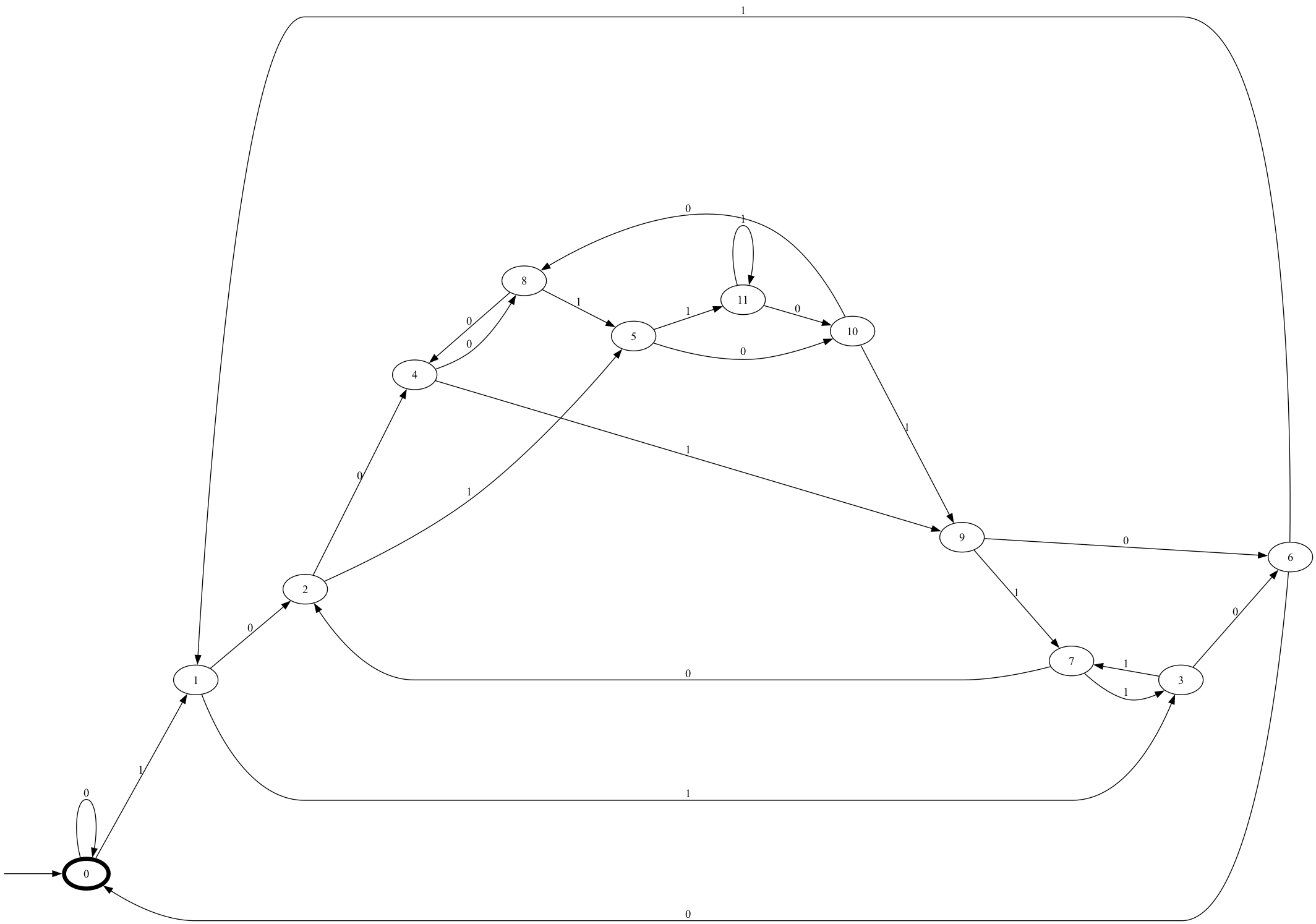
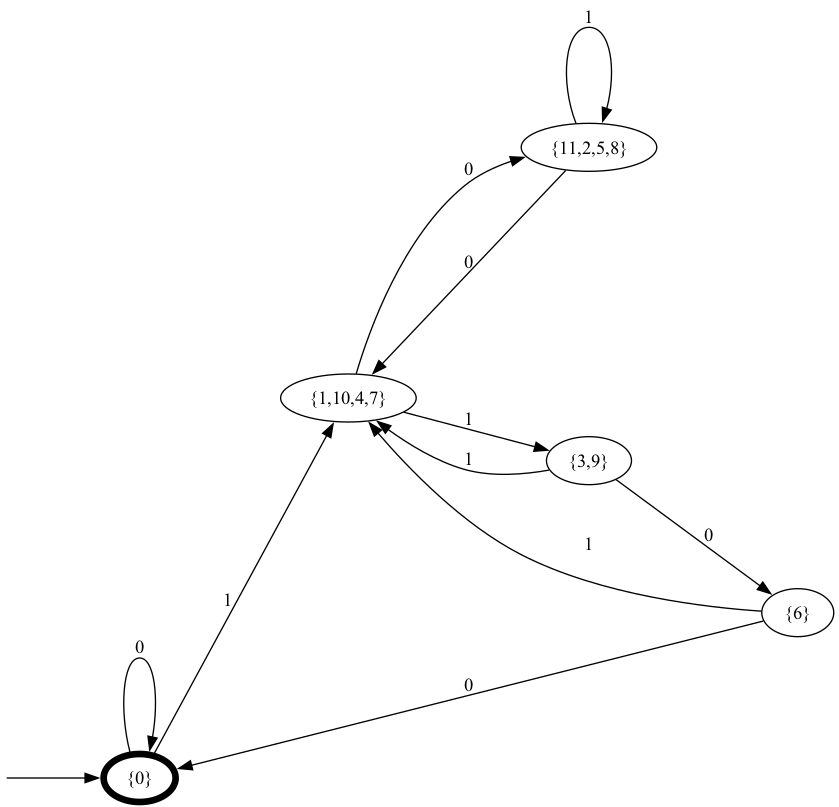
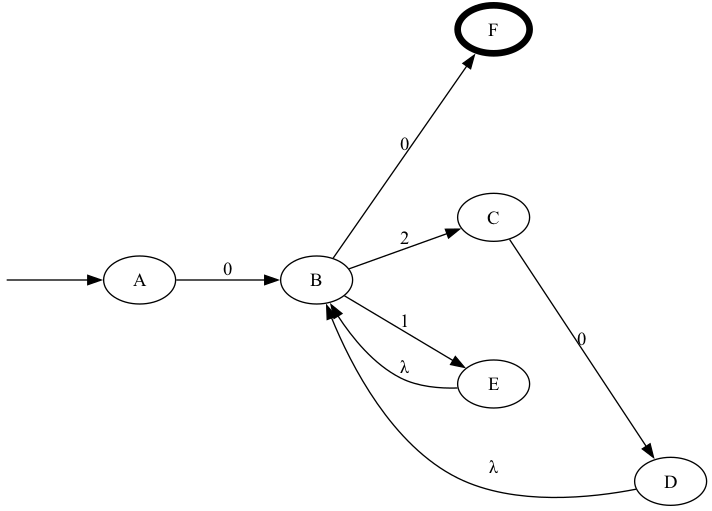
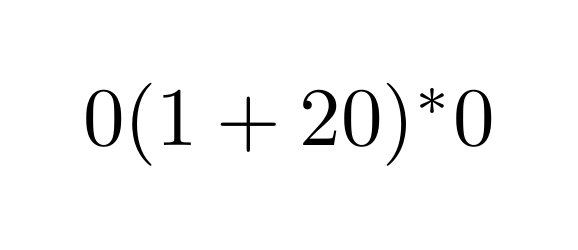
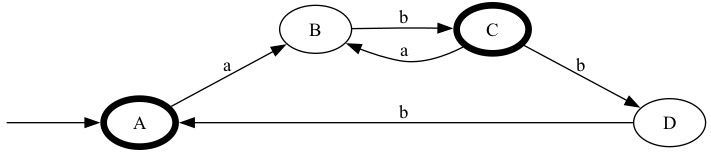
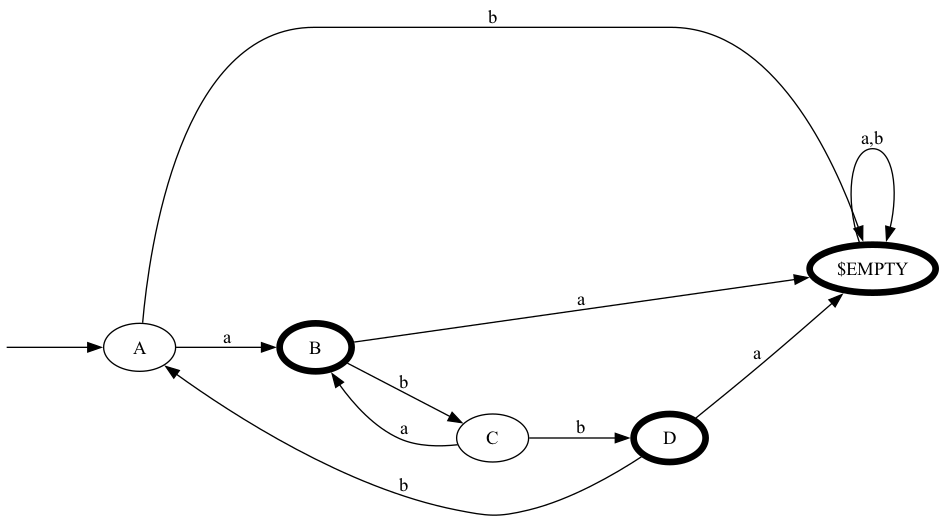
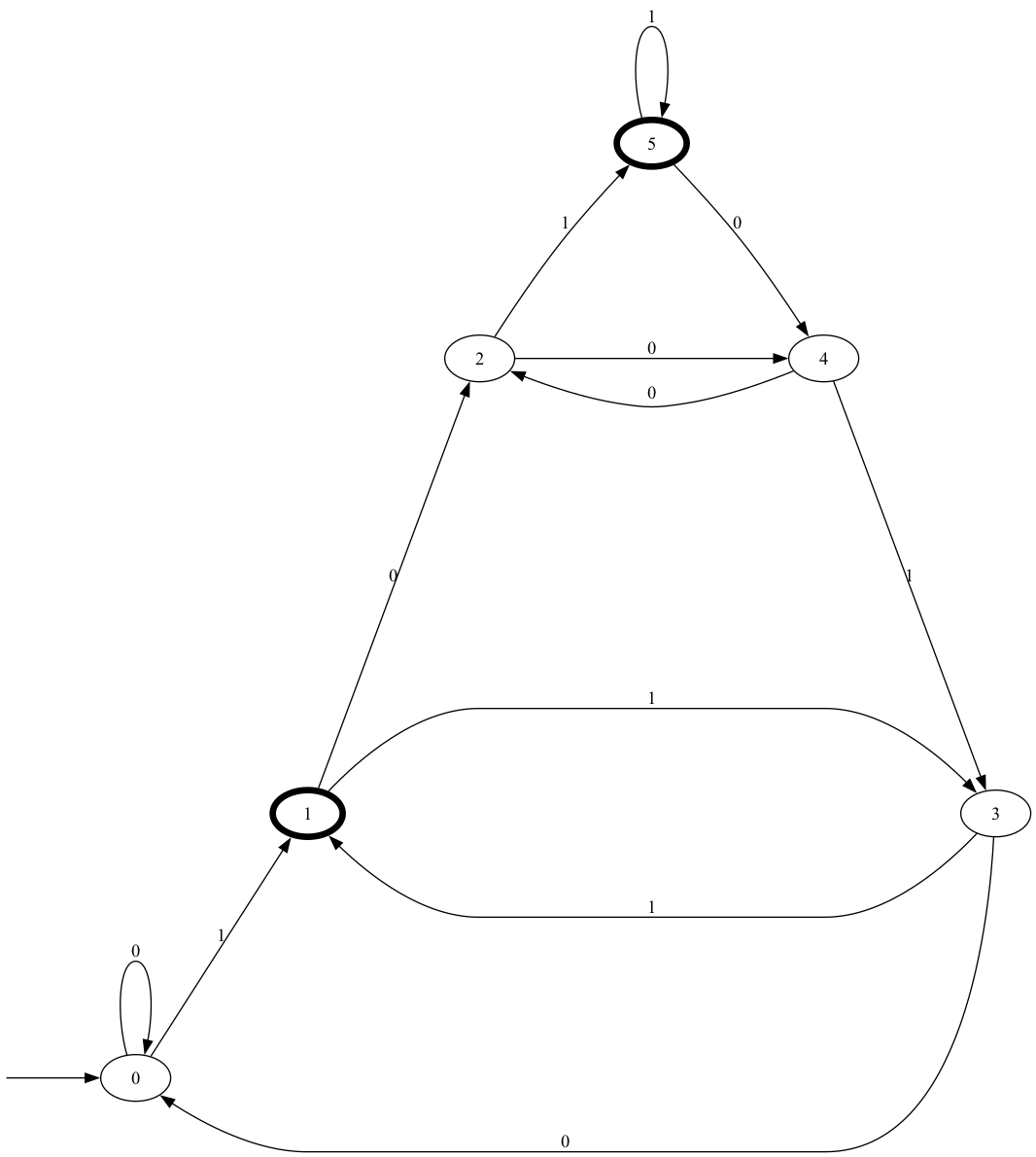
Conversion input above. Generated output below.
"a (b (b* + a + λ) + λ(a + (ab + b + λ)* bb)) b(ab)*"

N = { 1, 5 }, M = 6
To contibute to this project, please submit a Pull Request documenting what features have been changed or added. There are no new features currently in development, but if you have ideas to collaborate on please reach out to mperlman@umass.edu.
Code released under the MIT License.