
A training-grade RL + evaluation environment for NetHack, built on a custom
NetHack fork (the third_party/NetHack submodule) driven through a ctypes
binding — nle / minihack are no longer used. The fork turns NetHack into a
controllable substrate: in-memory snapshot/restore and branching, portable
level blobs, secure state edits, and 17 live difficulty/generation knobs. On top
of it sits an LLM-agent harness with a skill + code-mode interface, a 13-tier
curriculum, a dozen-plus observation encodings, replay capture, a web console,
and an in-browser rollout viewer — those upper layers now live in NetHack-hub
and NetHack-console (see below). Hosted as an environment in Prime Intellect's
Verifiers library.
Mirrors:
- Prime Hub:
jonathanliu/nethack(v0.0.66+) - GitHub:
liujonathan24/NetHack-engine(formerlyNetHackHarness)
Where things live. The monolith was split in #44; this repo is the engine only. Everything else moved:
| Repo | What it holds |
|---|---|
NetHack-engine (here) |
The engine: nethack_core, nethack_interface, the NetHack fork submodule, engine tests. |
NetHack-hub |
The harness / agent / experiment layer: environments/, approaches/, tools/, configs/, docs/, experiments/, wiki/. |
NetHack-console |
The website, live-play console, and rollout viewer — and the published site, https://liujonathan24.github.io/NetHack-console/. |
Start here: docs/CAPABILITIES.md (what the repo can
do) · docs/REPO_MAP.md (where everything lives + one turn,
end to end) · docs/engine-layer.md (the engine
reference) · docs/design.md (design doc).
Standard NetHack RL work runs on the nle gym wrapper (and minihack for level
authoring). That wrapper exposes a step/observation loop and nothing underneath
it. By driving a custom fork through ctypes, this project adds capabilities
that the gym wrapper structurally cannot:
- In-memory snapshot / restore / branch. Capture the entire game state —
engine context, coroutine stack, arena, display mirror — in constant time and
restore it byte-for-byte.
branch(n, reseed=True)forks the same position intondivergent rollouts with no action replay. This is live Monte-Carlo lookahead, not a save-file reload. (nlehas only TAS-style seed+action replay, which is O(steps).) - 17 parametric difficulty / generation knobs. Vision radius and fog,
damage/HP/hunger/spawn/XP scales, and generation-time controls for room
density, room size, mob spawn, traps, locked doors, and corridor connectivity —
tunable live or at reset.
minihackrequires authoring a fixeddesfile per variant; here difficulty is a continuous dial on the real dungeon generator. - Portable level blobs.
save_level/load_levelin NetHack's ownsavelev/getlevformat — serialize and reload a concrete level, not a scripted description. - Secure, bounds-checked state edits.
modify(hp=…, gold=…, goto_depth=…, …)applies only whitelisted, range-validated mutations — useful for constructing exact eval scenarios without hand-playing into them. - One canonical map model behind every encoding. ASCII, JSON, TOON, and the tile/tty image renders all read from a single typed model, so encodings cannot drift — which is what makes a clean observation-encoding comparison possible.
- Dual agent interface. A skill registry (one function-tool per skill) and a
sandboxed
code(source=…)mode over annhnamespace with a queryable map and sub-LM tools — beyond raw action indices.
Measured result: on matched seeds, a Qwen3-VL agent reaches mean max dlvl
2.74 ± 0.41 (uncompressed ASCII + pet), clearing NetPlay's GPT-4 figure of 2.6;
the single biggest lever turned out to be uncompressing the ASCII map. See
docs/netplay-parity-report.md.
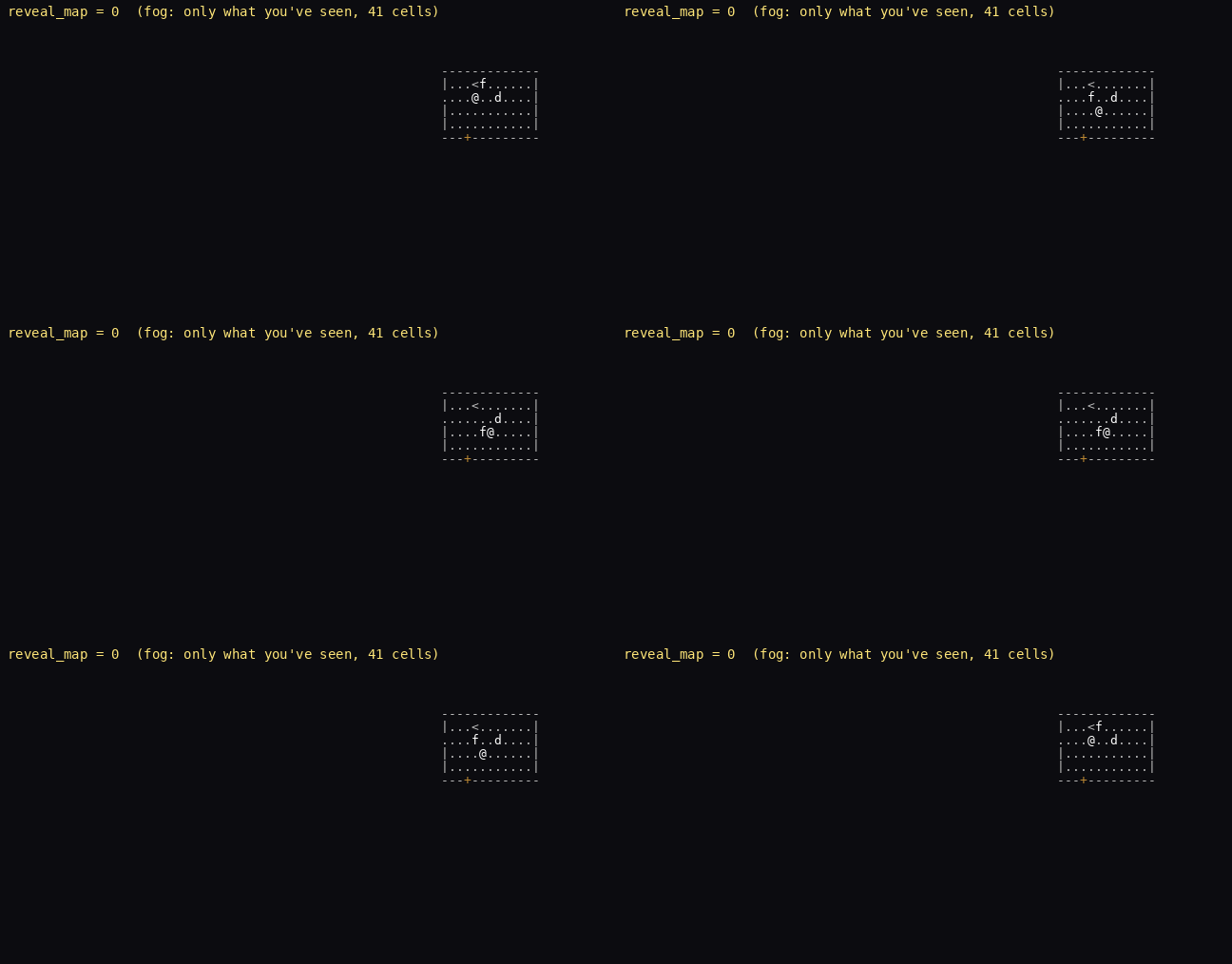
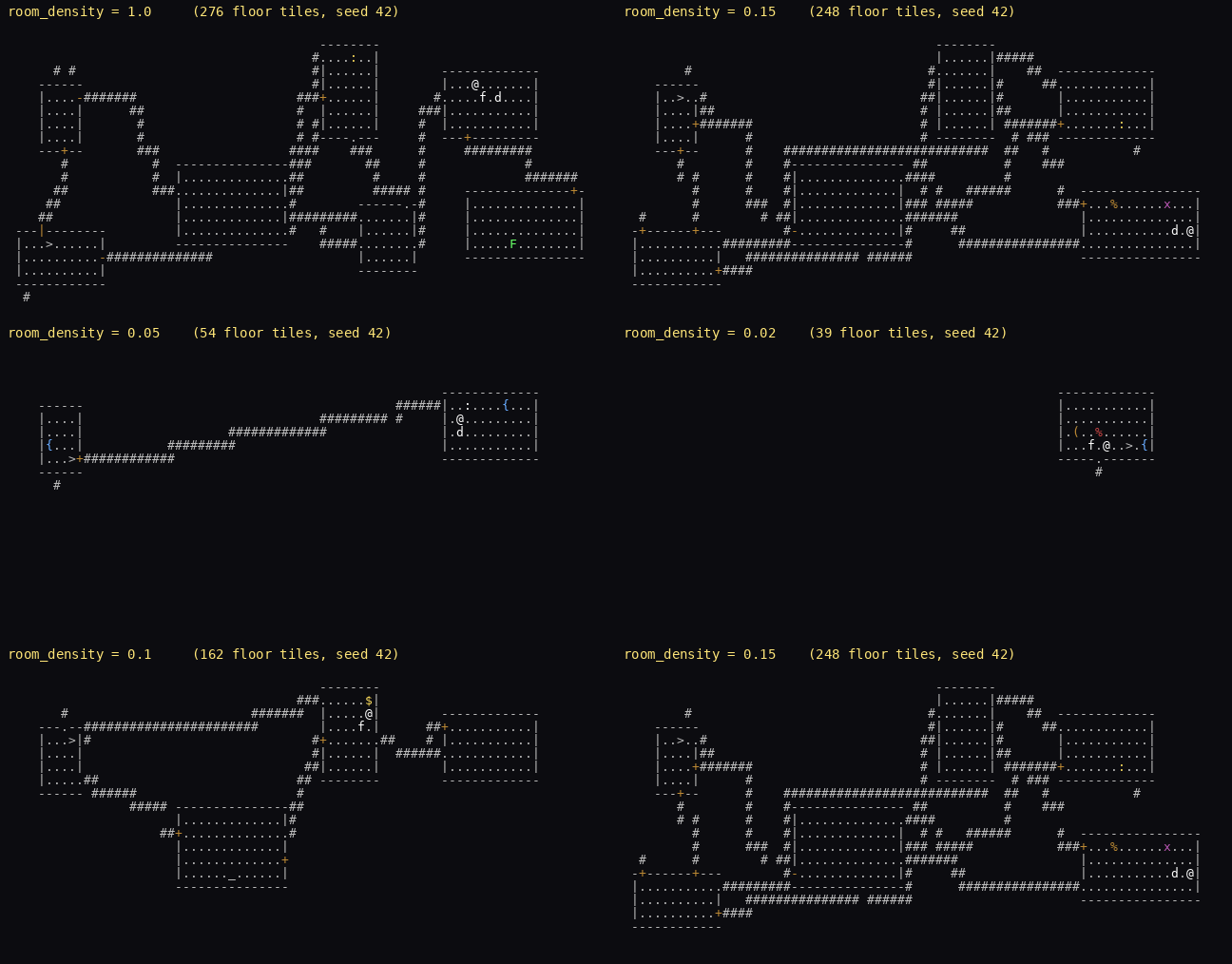
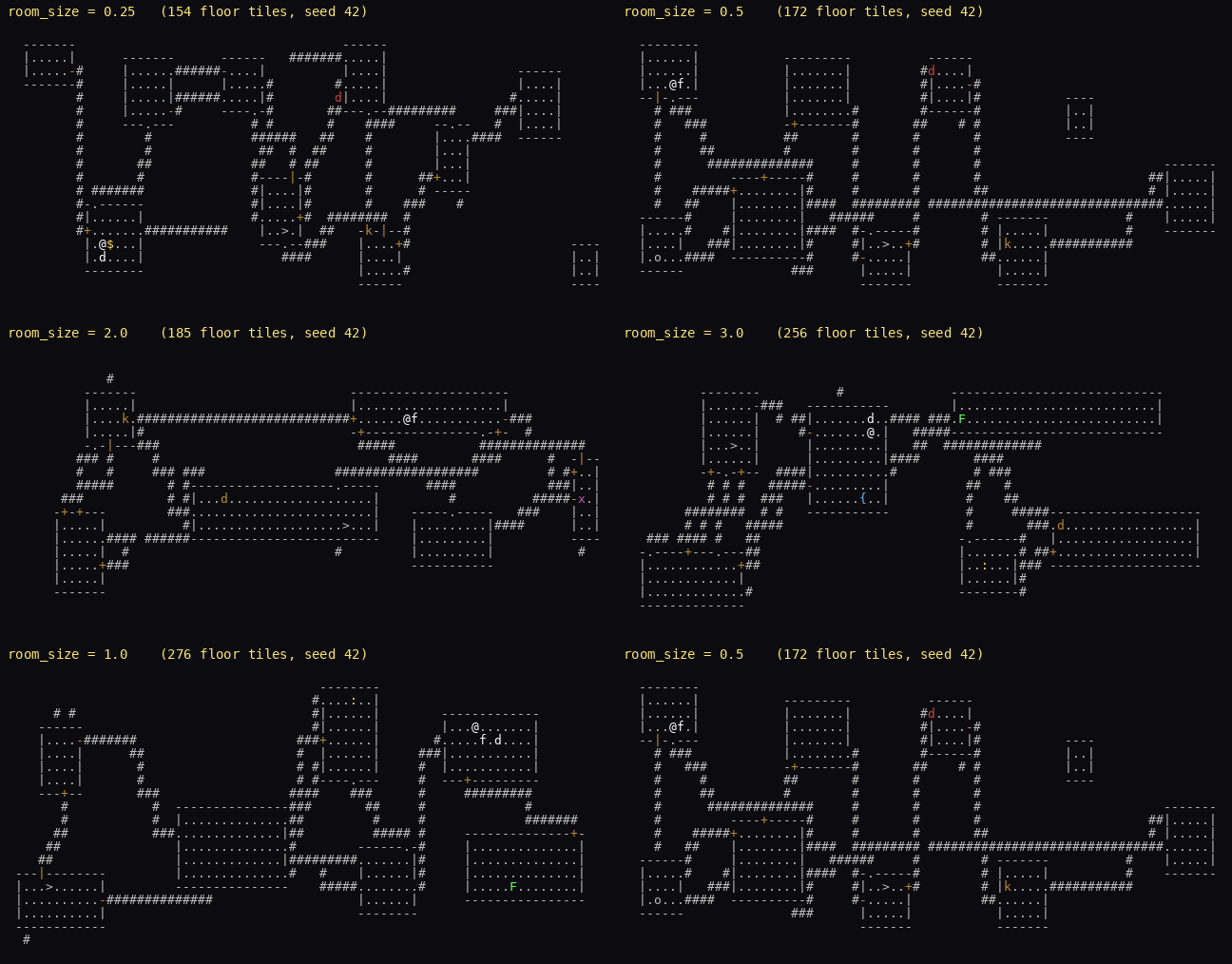
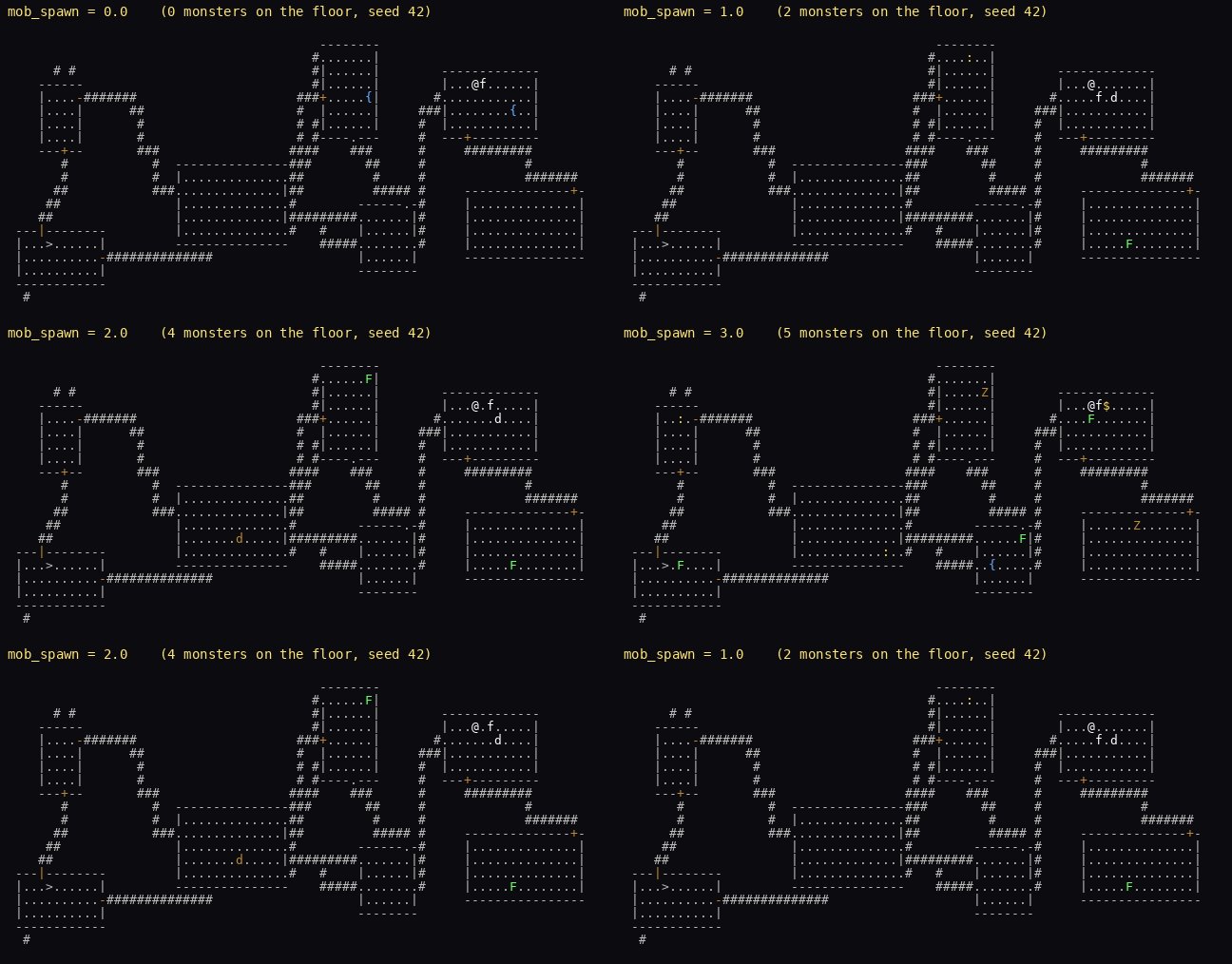
Difficulty & generation knobs — the same seed, re-rolled across knob values
(rendered by tools/knob_gifs.py, in NetHack-hub):
| Fog of war → full reveal | Room density |
|---|---|
 |
 |
| Room size | Mob spawn |
 |
 |
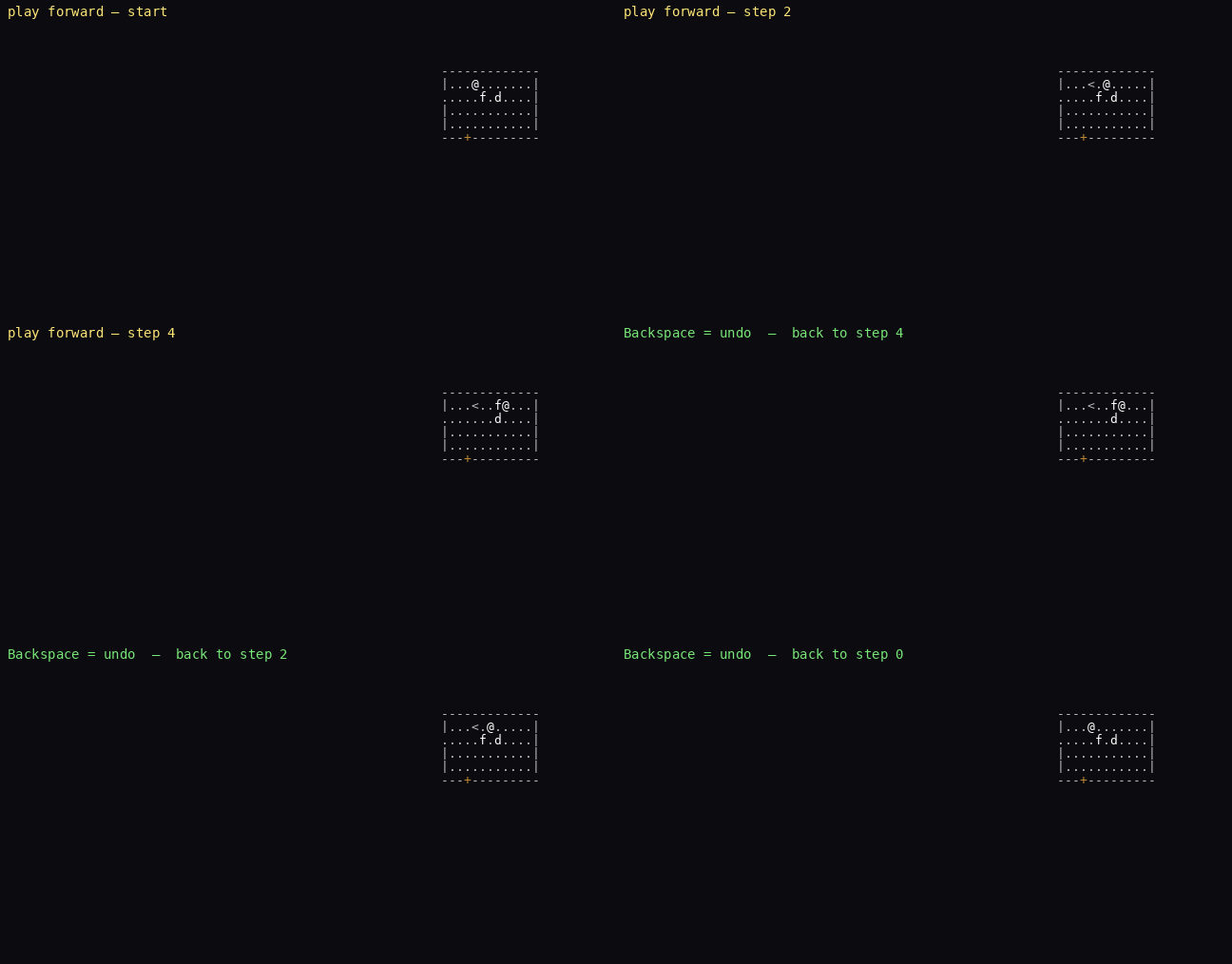
Live snapshot / restore — play forward, then step back through in-memory
snapshots (the same mechanism behind the web console's Undo and Checkpoint
buttons and branch(n)):
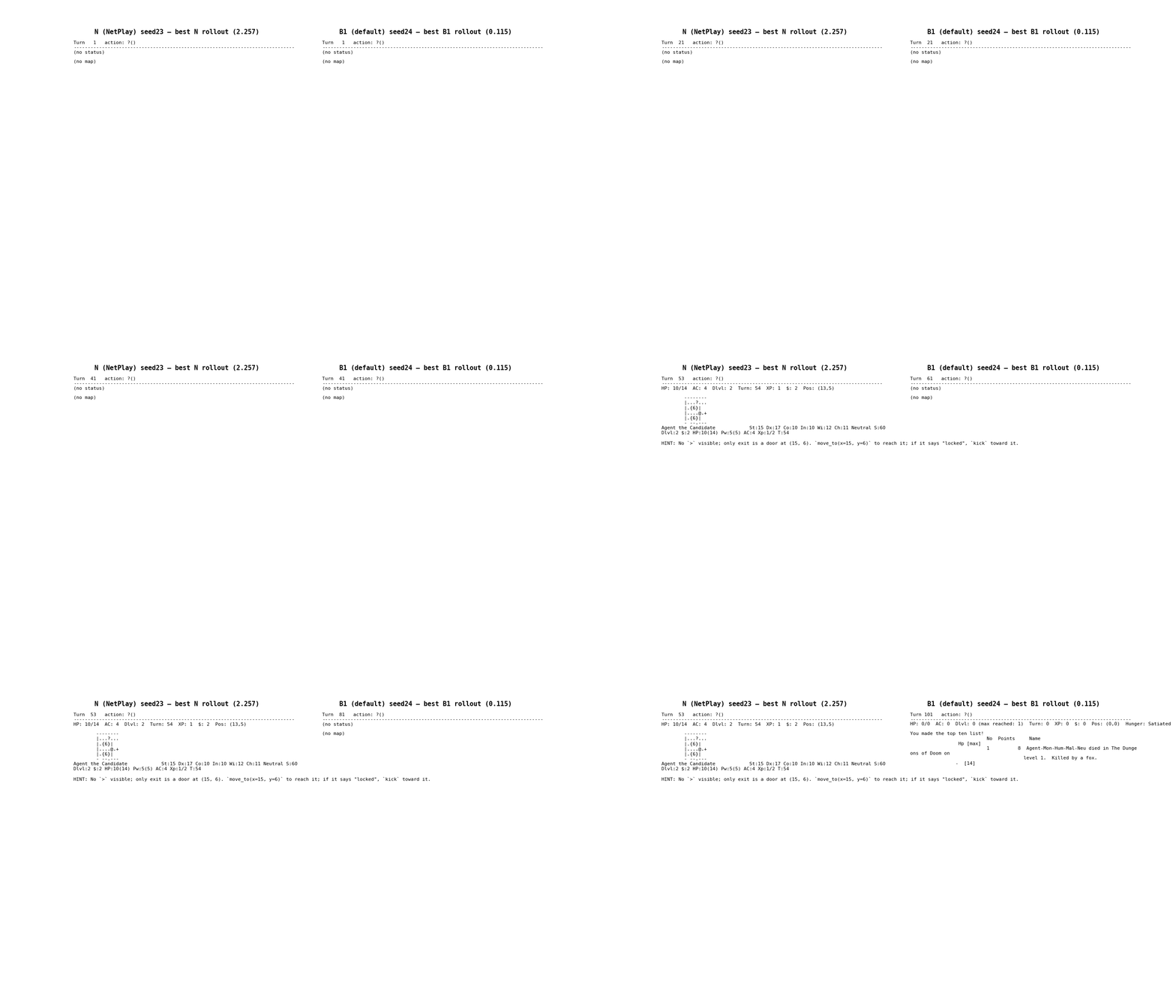
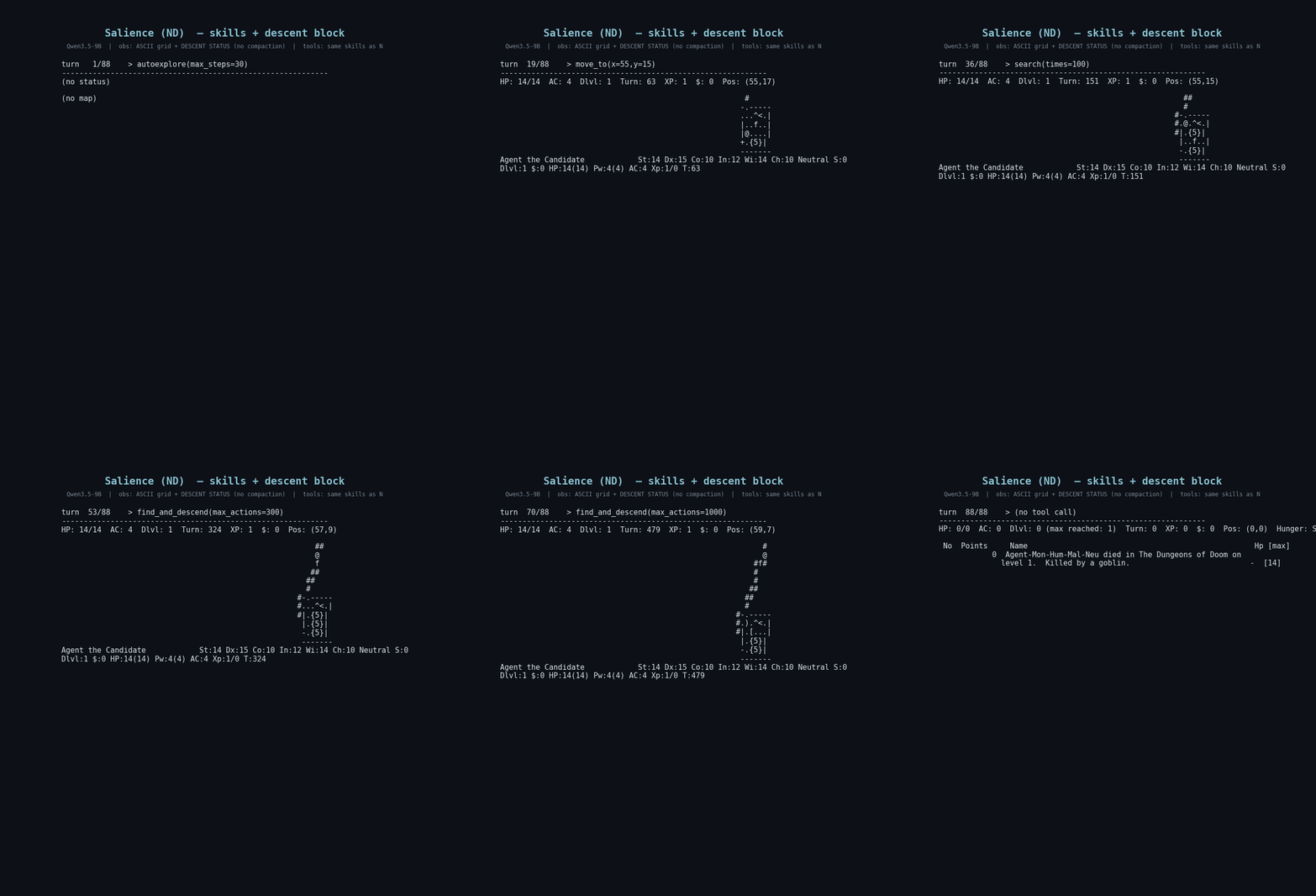
What the model actually sees — the rollout viewer / web console show the exact LLM input per turn. Encodings compared side by side on one seed:
| NetPlay-style vs. B1 ASCII | Salience / dir8 variants |
|---|---|
 |
 |
Both moved out of this repo in #44 and now live in
NetHack-console, which
also publishes the public site:
- Play it in the browser, no install: https://liujonathan24.github.io/NetHack-console/ (mirrored at https://liu-jonathan.com/nethack/) — a client-side WebAssembly build of this engine. Pages: Intro, Replays, Map Viewer.
- Flask live-play console (
tools/play_server.py,Dockerfile.console) —/mapplay with live difficulty knobs and snapshot-backed Undo / Checkpoint,/obsobservation builder,/tracesrollout scrubber. - Rollout viewer (
tools.rollout_view.live_server) — game state beside the exact LLM input per turn, plus/browseand the/dashboardstats view.
Setup and run instructions are in that repo's README. It depends on this one
(nethack-core as a git dependency); nothing here imports it back.
The site used to be published from this repo. It is not any more —
deploy/pages-redirect/forwards this repo's old Pages URL to the console. Seedeploy/pages-redirect/README.md.
A uv workspace whose layers separate the bare environment (for RL algorithms)
from the full harness (for chat-based LLM agents) over the same engine. See
docs/REPO_MAP.md for the full map and the turn-by-turn data
flow.
-
nethack_core/— interface-agnostic substrate. The ctypes binding (_engine.py), the deterministicEngineEnv(snapshot/restore/branch, level blobs,modify(), the 17-knobtunecatalog),NetHackCoreEnv(gym wrapper, seed-before-reset), observation shaping, and the canonical typed map model. -
nethack_interface/— a typed, pysc2-style interface:Observation/Action/ specs, with the action schema derived from the skill registry and a raw action-index escape hatch. Layers above the engine live in other repos since #44: -
environments/nethack/(inNetHack-hub) — the verifiers wrapper for the Prime Hub (nethack.py: load_environment) plus thenethack_harness/package (prompt variants, curriculum, skills, navigation, memory, refiner). -
approaches/(inNetHack-hub) — standalone agent strategies (go-explore, voyager, rlm, continuous-harness). -
tools/(inNetHack-hub, console parts inNetHack-console) — the knob-GIF renderer and encoding-comparison harness; the web console and rollout viewer + stats dashboard.
# system deps for the NetHack fork build (Debian/Ubuntu)
sudo apt install -y cmake bison flex libbz2-dev

# fetch the NetHack fork submodule + build libnethack.so
git submodule update --init --recursive
bash nethack_core/build_engine.sh   # -> third_party/NetHack/src/build/libnethack.so

# install the uv workspace. --all-packages is REQUIRED: numpy/gymnasium used to
# arrive transitively via nle; with nle/minihack removed they are direct
# workspace deps and a bare `uv sync` under-installs.
uv sync --extra dev --all-packages

# smoke test (no API keys) — the engine suite, 8 files
pytest tests/ -q
The harness-level checks and the vf-eval / prime eval recipes moved with the
harness — run them from
NetHack-hub, which carries
environments/, configs/endpoints.toml, and the rest:
# in NetHack-hub (needs OPENAI_API_KEY or PI_API_KEY)
vf-eval nethack -m gpt-4.1-mini -n 1 -r 1 \
  -a '{"tier": "corridor_explore"}' --endpoints configs/endpoints.toml

# or hosted (uses Prime Inference, billed to your account)
prime eval jonathanliu/nethack -m Qwen/Qwen3.5-9B -n 1 -r 1 \
  -a '{"tier": "corridor_explore", "max_turns": 30}'
Key CLI gotcha: pass env config via -a (env-args, goes to
load_environment), NOT -x (extra-env-kwargs). interface="code" via -x is
silently ignored because the tool list is baked at construction time. See
docs/EVAL_RECIPES.md.
Everything below is a load_environment argument (pass as JSON via -a):
Interface — interface:
"skill"(default): one OpenAI function-calling tool per skill."code": a singlecode(source=...)tool running sandboxed Python against annhnamespace exposing all skills + a queryablenh.map+ sub-LM tools (nh.summarize/plan/recall_lm).
Observation encoding — variant (from the variant registry):
| variant | what the model sees |
|---|---|
B1 (default), B0 |
canonical ASCII map + status/inventory/adjacency (compacted / uncompressed) |
B |
BALROG natural-language scene (no ASCII grid) |
G |
glyph-box render (pair with interface="code") |
JSON, TOON |
the canonical map model serialized as structured text (map_detail = full/minimal) |
IMG |
rendered NetHack tiles (image is the sole spatial channel) |
IMG_TTY |
tty-text raster image |
ND, FD |
descent-salience blocks |
E1, E2 |
frontier-surface obs (text blocks / painted onto the map) |
R |
summarize-and-reset history compaction |
P, CH |
Continual-Harness self-refinement (P) / full continual harness (CH) |
Skill set — skill_set: "full" (default), "move", "dir8",
"netplay" (Jeurissen CoG 2024 profile), or a comma-separated allowlist.
Curriculum — tier (13 tiers): empty_room, solo_combat, multi_combat,
corridor_explore, mini_dungeon, mines_to_minetown, sokoban_complete,
oracle_consult, full_dungeon_easy, full_nle (default — the standard
ascension game), dynamic_subgoal, quest_complete, castle_reached. Pass
tier=None to sample uniformly across tiers.
Game-setup overrides — by default the env is a plain standard NetHack game on
the fork engine. Customize the starting game with the interface knobs (all
default to vanilla): tune={...} difficulty/generation knobs (keys from
EngineEnv.tune.catalog() — vision_radius, reveal_map, mob_spawn,
room_density, room_size, trap_density, …), modify={...} whitelisted
starting-state pokes (hp/max_hp/gold/xp_level/hunger), and
level_blob=<path> to start on a custom saved level.
Memory / history — history_keep_full, history_drop_after,
belief_state_interval, journal_render_max_chars, continual +
continual_lives (auto-reset on death, preserving journal/belief state).
Capture — trace_dir: write per-turn NDJSON (raw grid, structured obs,
rendered message, tool calls, action, reward, dlvl, hp) for the rollout viewer.
Rewards are always scout_reward + descent_reward + success_reward +
ascension_reward (a vf.Rubric).
Run from NetHack-hub — the env
package and tools/bundle_for_hub.py live there now:
uv tool install prime
prime login
python tools/bundle_for_hub.py    # vendor nethack_core into the env package
cd environments/nethack
prime env push --visibility=PRIVATE --auto-bump
bundle_for_hub.py is critical — the Hub installs only environments/nethack/
as a tarball, so the workspace dep nethack-core is unresolvable there. The
script copies the substrate into environments/nethack/nethack_core/ so the built
wheel is self-contained.
main— the clean public tree.experimental— everything onmainplus the internal process artifacts: the OpenSpec capability specs and change history (openspec/), per-fix onboarding walkthroughs (docs/onboarding/), the regression experiment suite (experiments/), the launchpad TUI (tools/launchpad/), and scratch logs. This is the working branch for ongoing development.
Env v0.0.66+ on the Hub. Default is the standard NetHack ascension game
(full_nle) on the fork engine; curriculum tiers and the difficulty/generation
knobs are opt-in overrides. Default variant B1. Engine tests green. Active
research axis: observation-encoding comparison across ASCII / IMG / IMG_TTY /
JSON / TOON, and continual-harness self-refinement.
Author: Jonathan Liu.