


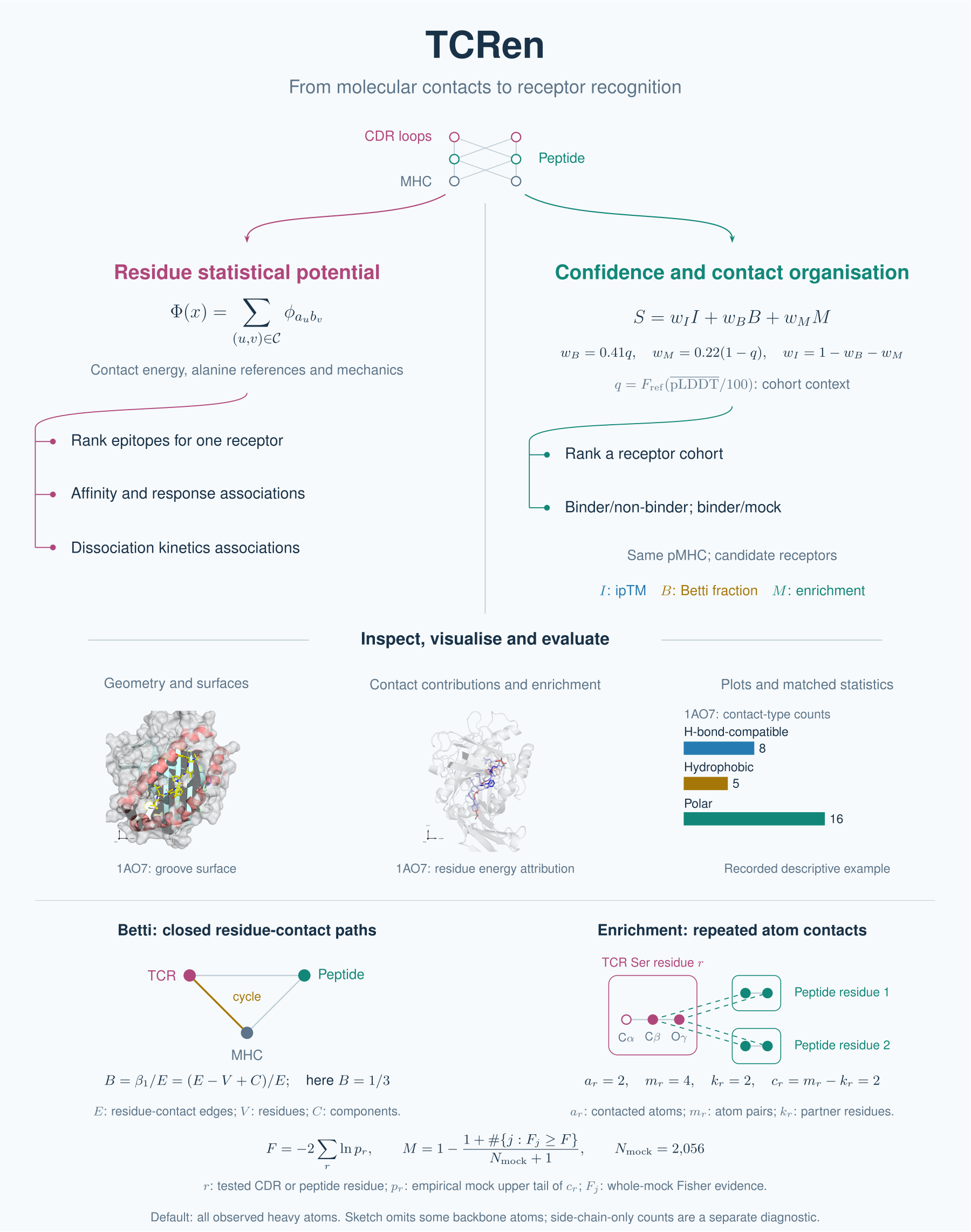
TCRen turns TCR–peptide–MHC structures into contact-based scores, receptor rankings and interpretable structural readouts. It brings two approaches into one Python library and command-line toolkit:
- Residue statistical potentials rank candidate epitopes for a fixed TCR and support studies of measured binding affinity, response magnitude and kinetics. Contact energies, structural alanine references and mechanical readouts retain their separate definitions.
- ipTM + Betti fraction + contact enrichment rank candidate receptors against one pMHC, including binder/non-binder and binder/mock comparisons. The default combines generator confidence with global contact organisation and local evidence calibrated against frozen mock structures.
Geometry, surface chemistry, contact attribution, molecular visualization and matched statistics help explain both routes.
| Question | Route | Worked guide |
|---|---|---|
| Rank epitopes for one receptor | score for fixed-template threading; screen --task epitope for separately modelled poses |
Epitope ranking |
| Rank a cohort of modelled receptors for one pMHC | screen --task tcr: ipTM, Betti fraction and enrichment |
Receptor screening |
| Rank paired receptor sequence candidates on a fixed template | score-receptors: fixed-contact CDR3 or observed-junction threading |
Candidate receptor scoring |
| How do structural scores relate to affinity or response magnitude? | Join measured endpoints, then evaluate --kind continuous |
Matched evaluation |
| How do contacts and mechanics relate to kinetics? | md, mechanics, then matched endpoint evaluation |
Dynamics and kinetics |
| Explore contacts, their contributions and enrichment | contacts, export, frozen motif readouts and residue-level attribution |
Contact evidence |
| Why does a model receive this score? | features, surface, superimpose and geometry diagnostics |
Inspect a model |
| How can I render or compare the evidence? | PyMOL scenes, contact maps, associate, evaluate |
Visualization gallery |
pip install tcren
tcren build-mhc-ref

tcren screen -s models.tar.gz --task tcr \
  --confidence confidence.tsv -o scores.tsv
Supply separately modelled candidate receptors for one peptide and MHC
background. confidence.tsv contains unique complex.id, iptm on [0,1] and
plddt on [0,100]; IDs match the structure stems. TCRen reads generator
confidence from metadata or this table. Annotation is batched internally, and
-t 0 selects the allocated CPU budget by default.
Wheels include five native extensions. ARDA provides TCR annotation and its first-use reference/search setup; the MHC reference is built on demand. The installation tutorial covers raw structures, input formats and first-run setup.
For peptides threaded onto one fixed template:
tcren score -s template.pdb -c peptides.txt --potential tcren2 -o energies.csvFor separately modelled peptides, use screen --task epitope. Its structural
alanine reference truncates peptide side chains in three dimensions and rebuilds
contacts before combining the energy difference with ipTM. Fixed-template
threading and separately modelled poses are different protocols.
S = (1 - 0.41*q - 0.22*(1-q))*ipTM + 0.41*q*B + 0.22*(1-q)*M
| Component | Structural meaning |
|---|---|
ipTM |
Generator interface confidence |
B |
Recognition graph cycle fraction, β₁/E, over CDR:peptide, peptide:MHC and CDR:MHC contacts |
M |
All-six-CDR/peptide local contact-cycle evidence, calibrated against 2,056 whole mock graphs |
q |
Inclusive percentile of unlabelled cohort-mean pLDDT against five frozen reference means |
For local enrichment, r indexes a tested CDR or peptide residue. Its statistic
is c_r = m_r - k_r: physical atom-pair contacts minus distinct partner residues.
a_r separately counts distinct contacted atoms. The default includes observed
backbone and side-chain heavy atoms; side-chain-only counting is available for
separate contact diagnostics.
The diagram sketches two contacted side-chain atoms making four contacts to two
peptide residues. The three inspection insets reuse public 1AO7 examples.
The weights are shared across a cohort: q = F_ref(mean(plddt)/100), using
the frozen five-cohort confidence CDF. Individual ipTM, Betti and enrichment
values still vary between models. The weights are nonnegative and sum to one. Mock histograms and compressed
whole-control calibration ship with the package; scoring fits no new parameters.
Missing active values use flagged frozen training imputation. Read screen_score,
component values, weights, missingness and availability reasons together.
Cohort mean remains the default. Models without TCR:peptide contacts receive
score 0, no_interface=true, a retained reason and a CLI warning. Never replace
this zero with raw ipTM. They do not count towards the default 30-model
floor. For one structure, explicitly select a representative confidence context:
tcren screen -s model.pdb --task tcr --confidence confidence.tsv \
  --confidence-context nearest-plddt --min-cohort 1 -o score.tsv
nearest-mean-plddt uses a small same-pMHC set's observed mean. Both alternatives
report support and distance to the selected frozen representative. See
confidence contexts.
Supplied MHC names retain their declared resolution, separately from sequence
representatives; exact allele identity is not a term in the default score.
Interpretation. These are structural rankings and measured-endpoint associations. Statistical contact energy is not physical binding free energy; the combined receptor score is development-selected and is not a calibrated binding probability. Representative confidence bins approximate cohort context. Keep matched populations, component readouts and every cohort gain or loss visible. Score definitions and reference dependencies give the full contracts.
| Example | What you can reproduce |
|---|---|
| Confidence-motif score notebook | Self-contained frozen-score example, components and confidence contexts |
| TCRvdb frozen-score reproduction | Accepted-score replay and matched comparisons from a supplied retained input bundle |
| TTD contact exploration | Inspect supplied TTDPSFLGRY models: contact chemistry, energy attribution and frozen enrichment |
| Contacts and interaction types | Atom/residue contacts and chemical interaction labels |
| Canonical molecular figures | Reusable PyMOL scenes and canonical views |
| Surface topology | Geometry and receptor-free pMHC surface readouts |
| CLI reproduction guide | Raw coordinates → exported components → matched binary or continuous evaluation |
The TCRvdb input bundle is supplied separately and is not distributed with the package. Frozen-feature replay and raw-coordinate reproduction are distinct checks. Public structure notebooks document their reference-data prerequisites; PyMOL examples additionally need the PyMOL executable. For scientific comparisons, pin the installed artifact and reference identities, preserve original labels and report exact membership alongside the metrics. SOURCES records the bundled parameter provenance.
One public 1AO7 structure (4,848 coordinate records), exporting 143 feature columns on an Apple M3 Max with one compute CPU and existing annotation references, took 7.70 seconds. The matched pre-optimization observation took 8.65 seconds; outputs were byte-identical. Each timing is one unprofiled run. Sampled process-tree RSS was 1.12 GB after the change and can double-count shared pages. Recorded workload and reference hashes make the scope explicit.
Pass a whole cohort in one command. Annotation searches and coarse descriptor workers use separate bounded phases; avoid an outer pool of all-core commands. Reference acquisition/index construction is separate setup work. See performance for CPU budgets, measurement and memory guidance; this single-structure example does not estimate cohort throughput.
- Learn: installation and first run, worked score notebook.
- Do a task: ranking, inspection, reproduction.
- Look up a definition: score contract, features, API.
- Understand the evidence: reference dependencies, confidence contexts.
./setup.sh --tests
.venv/bin/ruff check src tests
source .venv/bin/activate
make -C docs html SPHINXOPTS=-W
Changelog · API skill · Editable splash source
TCRen is distributed under the ISALGO LAB Academic and Non-Commercial Research License, version 1.0.