
A Paper/Folia plugin port of Racks that adds wooden display racks for tools and weapons. Rewritten with SQLite storage, native ItemStack serialization, permissions, and added features like WorldGuard/GriefPrevention integration and multi-language support.



- Minecraft: 1.21.11+
- Server: Paper/Folia or compatible fork
- Java: 21
| 12 wood variants | Oak, spruce, birch, jungle, acacia, dark oak, mangrove, cherry, pale oak, bamboo, crimson, warped |
| Floor and wall racks | Two slots on the floor, one on a wall, each with its own frame and click areas |
| Per-player language | Each player reads their own client language; fully translatable, see Language |
| Custom item NBT data | Enchantments, custom names, lore and other NBT data survive being placed on a rack |
| Data pack migration | Racks left standing by the original data pack can be imported on request |
| WorldGuard / GriefPrevention | Breaking a rack or swapping its item is checked against regions and claims, if either plugin is installed |
 |
 |
 |
 |
Three planks in a row, two sticks below the ends. Any of the twelve woods works. Put it on the floor or hang it on a wall, and display your gear on it. Right-click to swap an item in or out, sneak and right-click to change how the items are angled, left-click to take the rack back down.
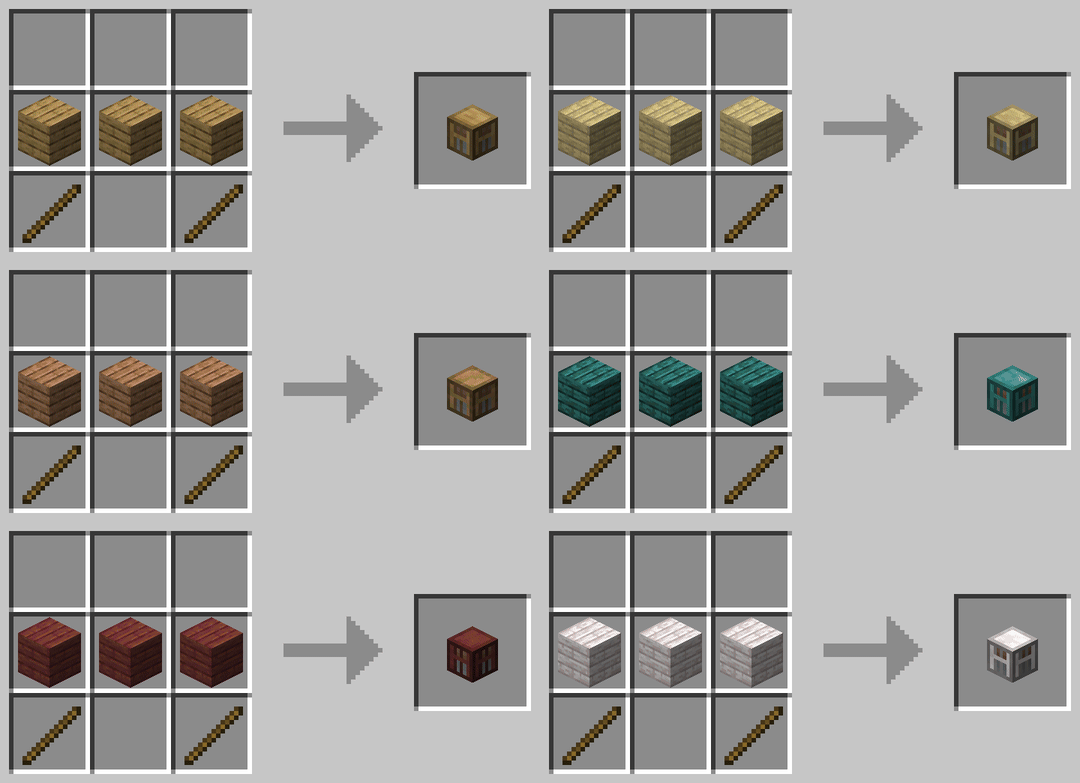
Floor racks take axes, hoes, pickaxes, shovels, spears, swords, maces, carrots on a stick, warped fungus on a stick and fishing rods. Wall racks take all of those plus bows, crossbows, tridents, shields, shears and spyglasses. Holding anything else and right-clicking does nothing at all.
This goes by the item's actual type, not its name or texture, so a reskinned axe, sword, bow and so on from ItemsAdder, Oraxen, Nexo or similar plugins goes on a rack the same as a vanilla one.
| Command | Permission | |
|---|---|---|
/racks give <variant> [player] [count] |
racks.command.give |
Hand out a rack |
/racks reload |
racks.command.reload |
Re-read config.yml and the language files |
/rack is an alias.
| Node | Default | |
|---|---|---|
racks.use |
true |
Place racks, swap items, change pose, break them |
racks.command.give |
op |
|
racks.command.reload |
op |
racks.use defaults to true because the data pack gated nothing. Out of the box the plugin behaves
identically. Negate it for a group to restrict racks.
Every message and item name ships in English and Vietnamese, and each player automatically sees
whichever one matches their own client language. Operators can add more: drop a
language/<locale>/messages.yml file next to the bundled ones and translate it, then
/racks reload picks it up.
Breaking a rack, swapping its item or turning it is checked against WorldGuard regions and
GriefPrevention claims. Nothing needs configuring beyond having the protection plugin itself
running. Putting a rack down is a normal BlockPlaceEvent, so both plugins already cover it.
| Rack action | WorldGuard flag | GriefPrevention trust |
|---|---|---|
| Break | block-break |
Build (/trust) |
| Swap an item, or turn the rack | interact |
Container (/containertrust) |
Operators and worldguard.region.bypass skip WorldGuard's checks. A GriefPrevention claim owner,
anyone trusted, admin claims and a player's /ignoreclaims toggle are all respected already, with no
extra permission to grant. See
Protection Plugins for the full breakdown.
Warning
Remove the data pack before starting the server with this plugin. If both are installed they will fight over the same entities.
Set adopt-datapack-racks: true in config.yml (it is false by default) and the plugin imports
racks the data pack left standing. It reads each one off the entities that make it up: the wood from
the block its frame displays, the direction from the yaw those displays were turned to, the contents
from what the item displays are holding, and even the pose, by matching the display's transform
against the same tables the data pack applied. The old entities are then removed and a plugin-owned
rack is built in their place, holding the same items in the same pose.
This happens per chunk, as chunks load, so a large world migrates gradually rather than all at once.
Two things cannot be recovered, because they lived only in the data pack's command storage, which has no API:
- The recorded owner is lost. The data pack stored it but never used it, and neither does this plugin.
- The creation time becomes 0, meaning "old enough to drop", the same way the data pack treated racks placed before its own 3.0.0.
Rack items already in players' inventories keep working with no migration at all; they are recognised
by the custom_model_data string that has been on every version of the item. They are quietly
re-stamped into the plugin's own form the next time their owner logs in, which is what gives them a
name in the player's language instead of the data pack's fixed English.
Coming from Racks V.2? Run the V.3 data pack's from_v2 upgrade first. The plugin can only read V.3
racks.
./gradlew buildThe shaded jar lands in build/libs/Racks-<version>.jar. HikariCP is the only bundled dependency and
it is relocated under com.racks.libs; the SQLite driver comes from Paper's own classpath.
./gradlew runServerstarts a Paper 1.21.11 test server with the plugin installed.
cd docs
npm install
npm run docs:devThe original Racks data pack is by KawaMood
The rack designs, item textures, display transformations, poses, and every screenshot and recipe image on this page are KawaMood's work, used under the terms of the original license. Its plaque is relabelled here to identify this Paper and Folia plugin.
CC BY-NC-SA 4.0, the same license as the original data pack. See LICENSE.