I was looking at a map of central Tokyo and found businesses standing inside the
Imperial Palace grounds. A supermarket that belongs in Yurakucho Lumine, and a
musical instrument shop that belongs in Akihabara:
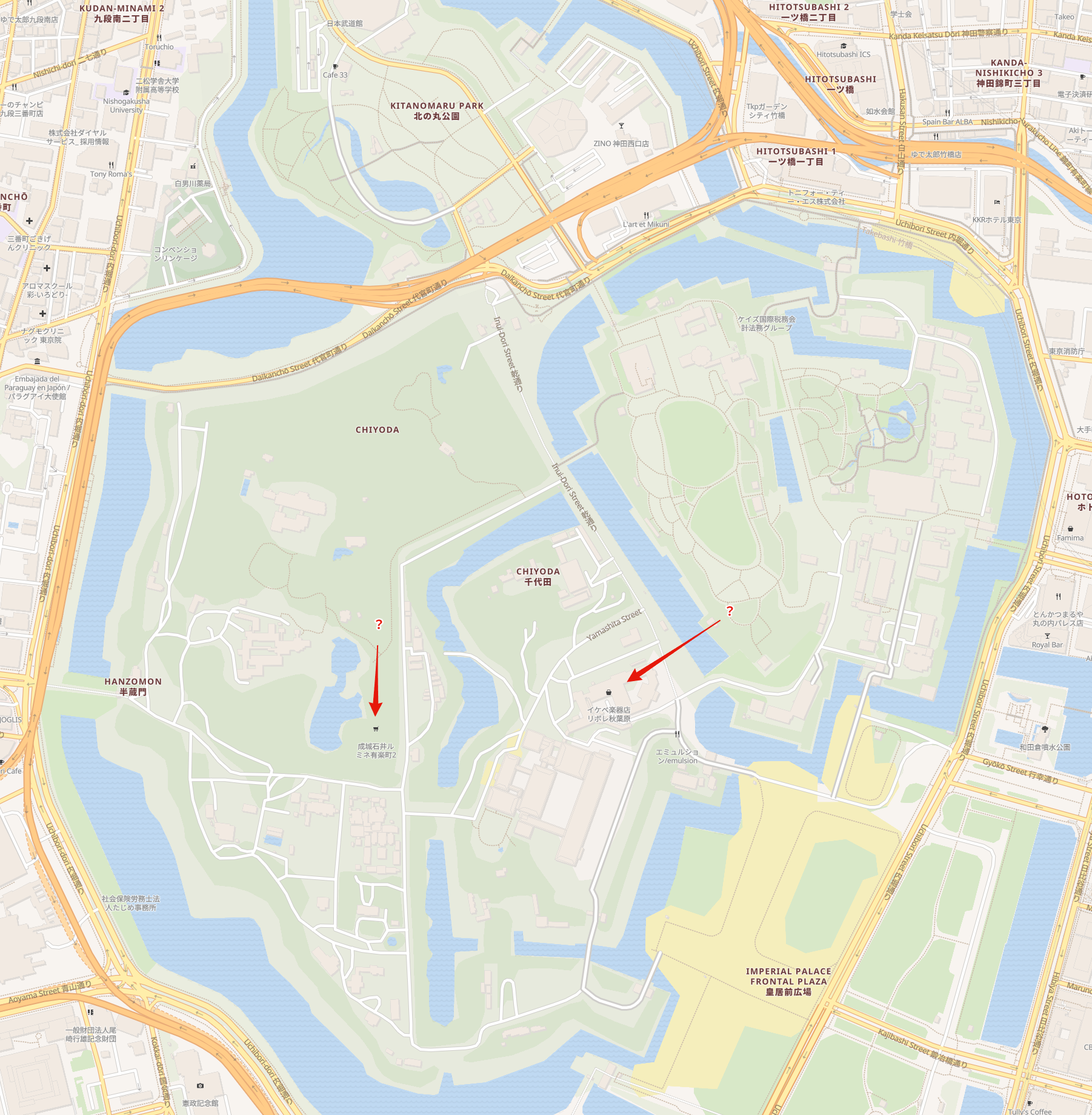
They are not alone. Two points inside the palace carry 71 and 17 places, all at
one coordinate each, to the last bit:
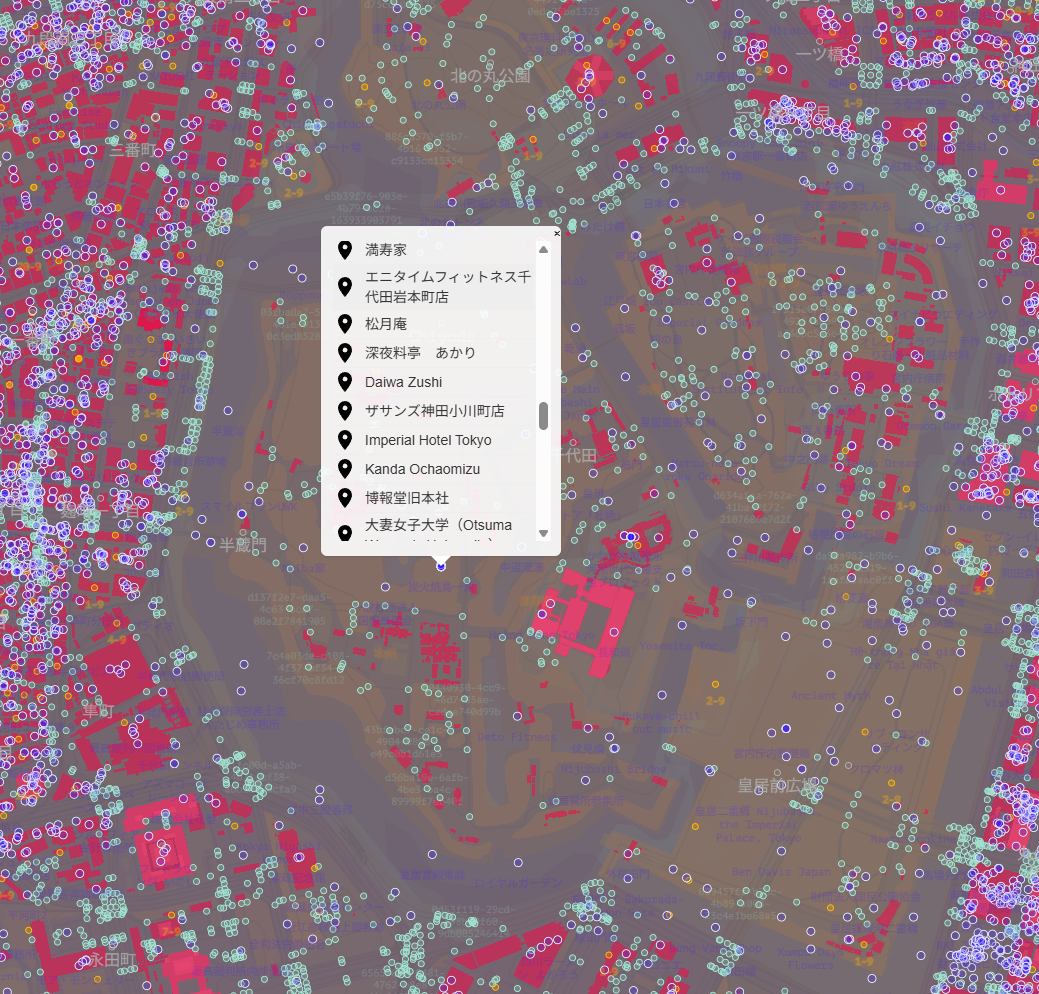
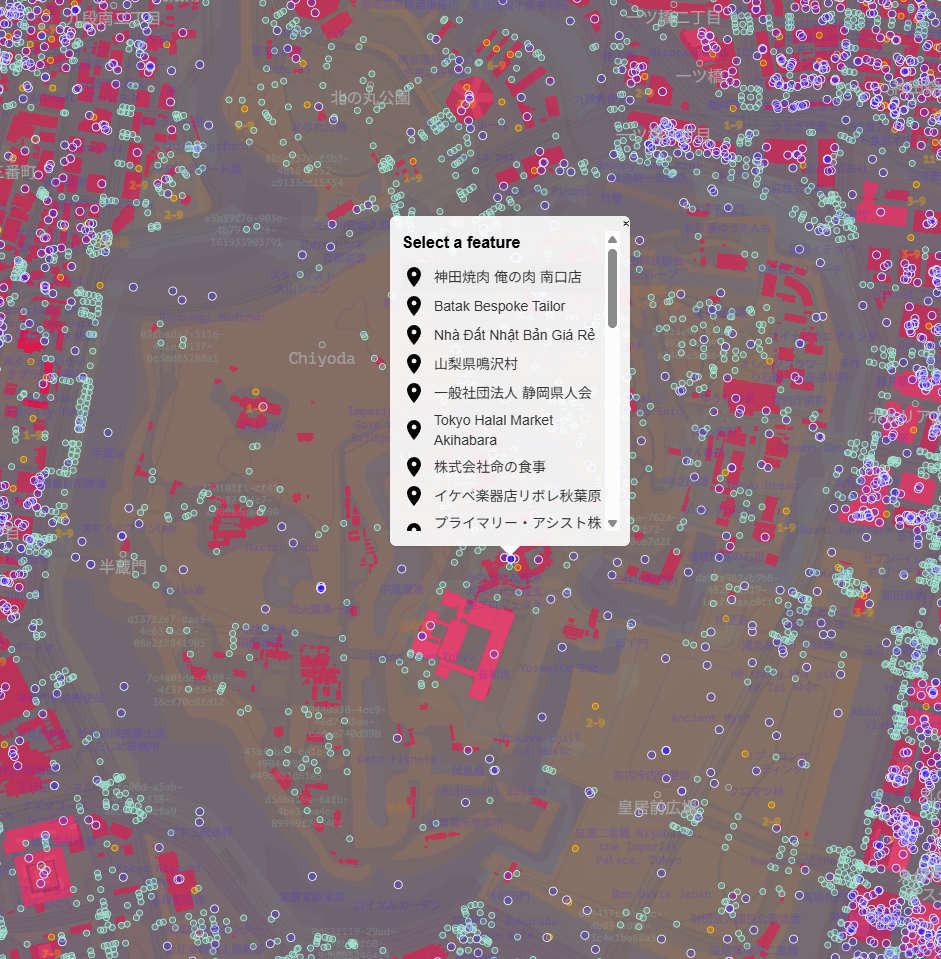
The first pin holds Imperial Hotel Tokyo and Otsuma Women's University. The
second holds a Yamanashi village office and a Shizuoka prefectural association.
61 of the 71 carry different street addresses, spread over nine city wards. The
addresses are largely correct. Only the geometry is gone.
Reproduce
Release 2026-08-19.0, DuckDB 1.3.2, about 80 seconds.
INSTALL httpfs; LOAD httpfs;
INSTALL spatial; LOAD spatial;
SET s3_region='us-west-2';

SELECT
  printf('%.7f', ST_Y(geometry)) || ',' || printf('%.7f', ST_X(geometry)) AS coord,
  count(*)                              AS places,
  count(DISTINCT addresses[1].freeform) AS distinct_street_addresses,
  count(DISTINCT names.primary)         AS distinct_names,
  round(max(confidence), 3)             AS max_confidence
FROM read_parquet(
  's3://overturemaps-us-west-2/release/2026-08-19.0/theme=places/type=place/*.parquet',
  hive_partitioning = 1
)
WHERE bbox.xmin BETWEEN 139.749 AND 139.755
  AND bbox.ymin BETWEEN 35.682  AND 35.685
GROUP BY 1
HAVING count(*) >= 5
ORDER BY places DESC;
coord places distinct_street_addresses distinct_names max_confidence
35.6833000,139.7500000 71 61 71 0.987
35.6838011,139.7539458 17 14 17 0.979
This is not local
Over the Japan bounding box (129-146E, 30-46N), 756 coordinates carry 10 or
more places each, 21,355 places in total, 0.74% of the 2,866,662 places there.
The biggest piles sit on rounded coordinates
Of the 2,811,678 distinct coordinates in that box, 5,750 are exactly
representable in four decimal places or fewer: 0.204%. Among the 107
coordinates carrying 50 or more places, 91 are: 85%. A 415-fold enrichment.
Geocoder output does not land on four-decimal values in bulk.
Not one upstream dataset
Of the 21,355 places in groups of 10 or more, by sources[].dataset:
meta 20,856, Foursquare 287, Microsoft 172, AllThePlaces 40.
confidence does not see it
The 71-place pile has a maximum confidence of 0.987 and a mean of 0.772. A
consumer filtering on confidence keeps all of it.
Also in the previous release
The same two coordinates in 2026-07-22.0 hold 80 places and 20 places.
A filter you could run
Two independent signals, tested as a union:
- The coordinate is exactly representable in four decimal places or fewer.
- Among places sharing the coordinate, at least 3 distinct
addresses[0].postcode, and distinct postcodes are at least 40% of those
that have one.
Postcode rather than street address, because genuine co-location has
inconsistent address strings but one postcode: Tokyo Station tenants show 15
distinct address strings across 16 places and 2 postcodes. Against every
identical-coordinate group of 7 or more in a 3km box over Chiyoda, labelled by
hand from names and addresses: 9 piles caught, 2 missed, 0 false positives, and
6 genuine co-locations correctly left alone.
Prior art
This is not a new observation, and I could not find it stated in this form.
What I think this adds: the fault is not drift, it is exact collapse; it is
measurable; and the coordinates carry a signature you can filter on without a
geocoder.
What I did not check
- Whether these coordinates come from upstream or are introduced during
conflation. I can only see the published parquet.
- Only
part-00015 was scanned and every number above is the Japan bounding
box. The same pattern is visible for South Korea in the same file
(37.5588600,126.9998900 carries 836 places). Other parts are unscanned, so I
do not know the global figure.
- The labels behind the 9/2/0/6 result are my judgment from reading names and
addresses, not field verification.
- The filter is untested outside Japan, where postcode coverage differs.
AI assistance
Investigated with Claude Code. The direction and the decisions are mine; the
querying, the search of prior issues, and the drafting are the assistant's.
Every number above comes from the query in this issue or from the same parquet
file, and the reproduction was run as written.
I was looking at a map of central Tokyo and found businesses standing inside the
Imperial Palace grounds. A supermarket that belongs in Yurakucho Lumine, and a
musical instrument shop that belongs in Akihabara:
They are not alone. Two points inside the palace carry 71 and 17 places, all at
one coordinate each, to the last bit:
The first pin holds Imperial Hotel Tokyo and Otsuma Women's University. The
second holds a Yamanashi village office and a Shizuoka prefectural association.
61 of the 71 carry different street addresses, spread over nine city wards. The
addresses are largely correct. Only the geometry is gone.
Reproduce
Release
2026-08-19.0, DuckDB 1.3.2, about 80 seconds.This is not local
Over the Japan bounding box (129-146E, 30-46N), 756 coordinates carry 10 or
more places each, 21,355 places in total, 0.74% of the 2,866,662 places there.
The biggest piles sit on rounded coordinates
Of the 2,811,678 distinct coordinates in that box, 5,750 are exactly
representable in four decimal places or fewer: 0.204%. Among the 107
coordinates carrying 50 or more places, 91 are: 85%. A 415-fold enrichment.
Geocoder output does not land on four-decimal values in bulk.
Not one upstream dataset
Of the 21,355 places in groups of 10 or more, by
sources[].dataset:meta 20,856, Foursquare 287, Microsoft 172, AllThePlaces 40.
confidencedoes not see itThe 71-place pile has a maximum confidence of 0.987 and a mean of 0.772. A
consumer filtering on confidence keeps all of it.
Also in the previous release
The same two coordinates in
2026-07-22.0hold 80 places and 20 places.A filter you could run
Two independent signals, tested as a union:
addresses[0].postcode, and distinct postcodes are at least 40% of thosethat have one.
Postcode rather than street address, because genuine co-location has
inconsistent address strings but one postcode: Tokyo Station tenants show 15
distinct address strings across 16 places and 2 postcodes. Against every
identical-coordinate group of 7 or more in a 3km box over Chiyoda, labelled by
hand from names and addresses: 9 piles caught, 2 missed, 0 false positives, and
6 genuine co-locations correctly left alone.
Prior art
This is not a new observation, and I could not find it stated in this form.
since May 2025.
showed Heathrow POIs with localities of Reading, Oxford and Slough in
August 2024.
maintainer reply attributing the drift to variation in upstream geocoders.
What I think this adds: the fault is not drift, it is exact collapse; it is
measurable; and the coordinates carry a signature you can filter on without a
geocoder.
What I did not check
conflation. I can only see the published parquet.
part-00015was scanned and every number above is the Japan boundingbox. The same pattern is visible for South Korea in the same file
(37.5588600,126.9998900 carries 836 places). Other parts are unscanned, so I
do not know the global figure.
addresses, not field verification.
AI assistance
Investigated with Claude Code. The direction and the decisions are mine; the
querying, the search of prior issues, and the drafting are the assistant's.
Every number above comes from the query in this issue or from the same parquet
file, and the reproduction was run as written.